Episode Transcript
[00:00:00] Speaker A: One of the coolest things about being a Catholic is that I don't have to feel it to know I'm getting it. Does that make sense? Dude, I could just buckle up, sit down on the roller coaster, and boom, I'm going. It's off.
I just got to be cooperative and show up. It's such a great grace. So we're going to talk about what that grace is, how to tap into it, how to get more out of it. We're going to talk about the sacraments. Grace guaranteed with Father Chris Alarm.
Welcome to the Chris Stefanick Show. We are here every week to give you the tools and inspiration you need to live your everyday life with joy. I want to thank our missionaries at Joy. You make this work possible. If you're not one, become one. Click below this video. Your monthly gift can change the the world.
Father Chris Alar, it is always so good to have you.
[00:00:55] Speaker B: Welcome. Thank you for welcoming me back.
[00:00:57] Speaker A: I love your work. I love what you do. We're going to link to his YouTube below this video. You're crushing it.
[00:01:01] Speaker B: Oh, this has been a blessing to be here with what you guys do. And we're all on the same team, right?
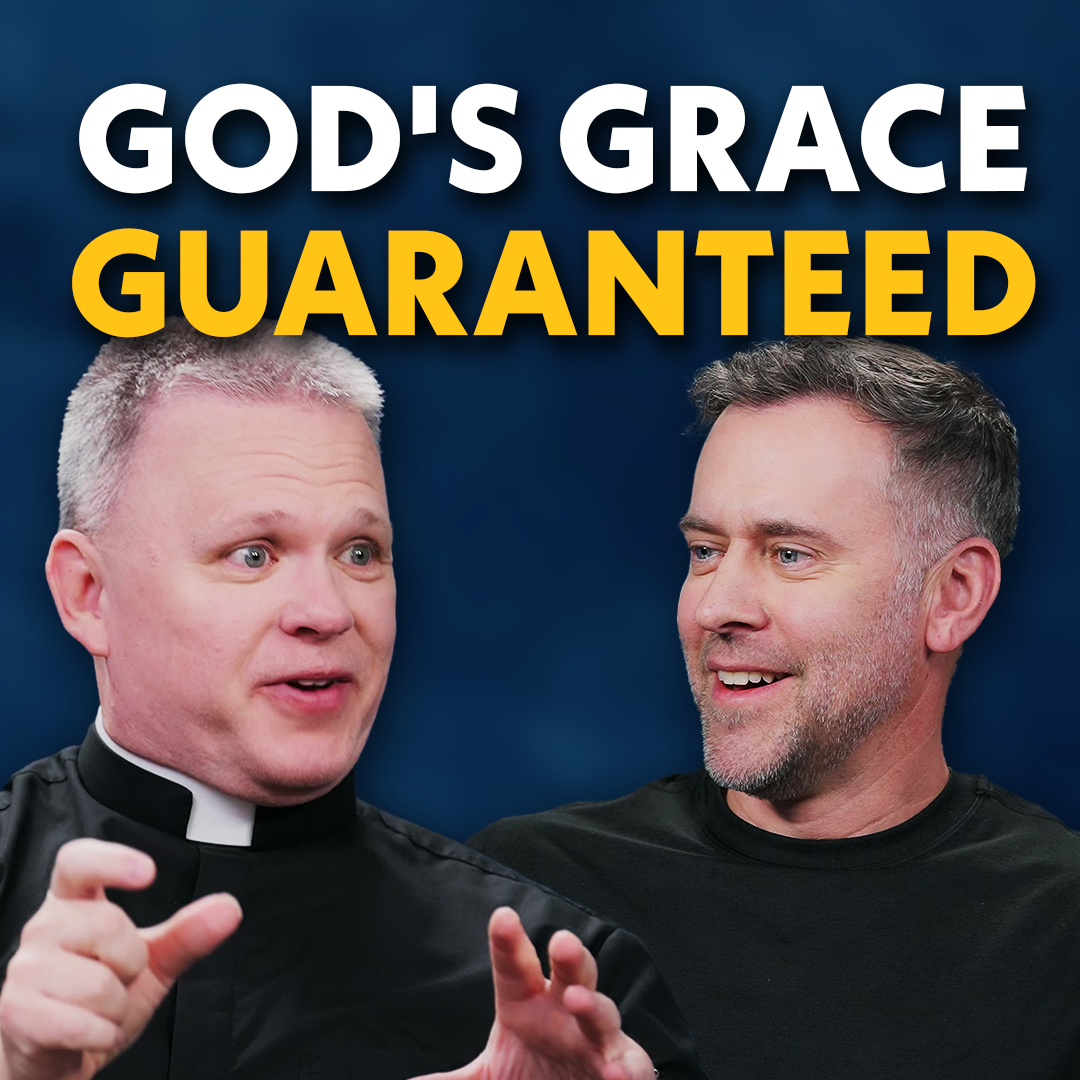
[00:01:07] Speaker A: Amen. Amen. Amen. You wrote a book, Understanding the Sacraments. God's Grace guaranteed.
I love the subtitle. God's Grace Guaranteed.
Tell me about that and why you need it.
[00:01:19] Speaker B: You know, it's funny because I never thought I'd be writing a book on the sacraments. Oh, there's a million books out there on the sacraments.
[00:01:25] Speaker A: Right, Right.
[00:01:26] Speaker B: But it wasn't until I started traveling and going around from parish to parish and diocese to diocese did I have any understanding of just the beautiful gift that we have at the sacraments that's not captured in the teaching about the sacraments.
It's amazing to me, when I would go to these parishes and I'd sit in on maybe one of their OCIA classes or I would. I just happen to get involved. And sometimes they say, father, can you come and do a Q and A with us? When I would talk about the sacraments, they really don't understand.
You think it's the most basic element of the Catholic faith, but so many Catholics think it's just a symbol. Many Catholics, because you were taught by our Protestant influence of our friends that it is just a symbol and it's not scriptural. And so I was blown away by learning things that the most practical aspects of the sacraments are not taught in any of these classes, like baptism.
One of the Biggest contentions is, well, I'm gonna let junior grow up to be 18 years old before he decides if he wants to be baptized or not.
Oh my gosh, the writings from the church, Father St. Augustine, who called it apostolic to baptize infants. This goes back way, even scripture. Peter and Paul talks about baptizing the entire household of Stephanus. I wonder if your name came from that Stephanus.
[00:02:55] Speaker A: I'm going with that.
[00:02:57] Speaker B: I didn't even think about that.
[00:02:59] Speaker A: We made it.
[00:03:00] Speaker B: I didn't even think about it.
[00:03:01] Speaker A: Stephanuses are there. Yeah, that's right.
[00:03:03] Speaker B: I never thought about it till now, but I was amazed that these are the types of things that they're finding out. It's like, okay, use that as an example. I'm not going to baptize the child because they need to be able to make that decision when they're 18. First of all, if you wait till you're 18, they're not going to get baptized. Okay, they're not going to do it.
But I want to ask every one of those parents, when that child was conceived and you learned you were pregnant, did anybody say, we're going to let this child become 18 years old before they determine if they want to be a member of our family or not?
[00:03:38] Speaker A: Huh?
[00:03:40] Speaker B: Did anybody say that? Yeah. No.
They're automatically, the day you learn of the baby, a part of your family.
[00:03:49] Speaker A: Amen.
[00:03:50] Speaker B: Why are we going to deny that child being a part of God's family when God wants them? I mean, why carry that ball and chain? Remember, the age of reason is seven years old, which is shocking to a lot of people.
[00:04:03] Speaker A: Yeah.
[00:04:04] Speaker B: You know, I remember being 8, 9 years old and neighbor kids torturing turtles and things. And I would just get so upset.
Those kids are culpable for that. They know better. That's the natural law. Torturing an animal is wrong. Stealing is wrong. And 8, 9, 10 year old kids are doing that. They're culpable. Why are you going to not give this kid the grace of the Holy Spirit, which comes at baptism? Faith, hope. And the greatest of these is love.
It doesn't mean we can't love something. If you're not baptized, it means you can't love on a supernatural level without being baptized. So this is just one of many examples.
[00:04:42] Speaker A: So if they're just thinking it's a symbol, well, then that would answer the question why they wouldn't do it. Because it's like, well, I'll just go through a meaningful ritual at 18.
[00:04:49] Speaker B: That's it.
[00:04:50] Speaker A: But that's, I mean, all the studies that came out about the Eucharist, what percentage of Catholics? 30% believe in the real presence, in the real presence. 70% think it's just a symbolic thing.
[00:05:00] Speaker B: And that's the influence of our non Catholic brethren.
We have to get back to the basics of learning. And so in our YouTube ministry, I started going into real details and deep in theology. When I started and I was giving seminary courses and I realized we got to go back and re catechize. We got to go back and re evangelize our own Catholics.
We don't know, you know, it's the sacrament itself.
Catholics don't even know what is a sacrament.
When you do the definition of a sacrament, think about the words. A sacrament is an efficacious sign. So it is in a way, a symbol. But not just a symbol, an efficacious sign that means it does something.
Efficacious means it does something.
What does it do? It gives you grace.
So it's an efficacious sign of this grace, this beautiful grace instituted by Christ, entrusted to the Church by which divine life is instilled in us.
That's the definition of a sacrament.
Do you ever hear more powerful words, even more than I love you, than divine life being instilled in you?
[00:06:23] Speaker A: There is nothing that's pretty powerful, man.
[00:06:25] Speaker B: Nothing. There's nothing anybody could say to me that's more powerful than God through his church saying, this is the way divine life is instilled in you. And yet we don't go to the sacraments. You know, the world is in a mess, Chris. Nobody's going to argue this, but I have a theory.
The world is in the mess that it is in because of this.
Our average age of the world leader right now is 45 to 60. That's the average age of the world leader.
When did we stop baptizing babies? 45 to 60 years ago, after Vatican II. It's not the fault of Vatican II. It's the misunderstanding and misimplementation of Vatican II.
[00:07:09] Speaker A: And a lot of people after that, there's data showing that they just stopped baptizing their infants.
[00:07:14] Speaker B: Stopped. They stopped.
[00:07:16] Speaker A: I had a priest that's messed up,
[00:07:17] Speaker B: a good priest friend that said that he did upwards of 200 baptisms a year. Last year he did 7.
[00:07:25] Speaker A: What?
[00:07:26] Speaker B: Yeah. Used to do upwards of 200 baptisms a year. Last year he did 7 of babies. Of babies.
[00:07:31] Speaker A: Oh, that's so tragic.
[00:07:32] Speaker B: Of babies. Absolute tragic.
[00:07:34] Speaker A: And so people are living graceless lives and wonder why they're eating in a Graceless way.
[00:07:38] Speaker B: If you don't have the grace of the Holy Spirit, you have no protection.
[00:07:44] Speaker A: Hey, friend. I want to invite you into something that's changing lives. Every single day, people all over the world are rediscovering their faith, finding real joy, and learning how to share the gospel with confidence. And guess what? These lives are forever being transformed because of our Missionaries of Joy, our incredible monthly supporters. Everything we do, the Chris Stefanick Show, Life changing video series, like Living Joy, Rise, Fearless and Renewed, our live events, it all exists because of them. And I want to invite you to become part of this movement. When you become a missionary of Joy, you're not just donating. You're stepping into a mission that equips, inspires and empowers you to live the gospel in your everyday life and to help others do the same. And that's not all. As a missionary at Joy, you get exclusive access to all our video series and empowerment to share them in small groups with friends. You get exclusive early access to new releases. You get Monday motivation texts direct from me. And you get access to our daily anchor, daily inspiration to fuel your faith. Here's the truth. The world is desperate for Joy. People are dying for me, and together we could bring them the hope of Jesus.
The question isn't if you can make a difference, it's will you click the link below. Join the mission Today.
There's a plaque in Okinawa where I think 40,000 people died in one battle. It said, war, after all, is a spiritual problem.
[00:09:15] Speaker B: Wow.
[00:09:17] Speaker A: You fix the problems of the world by giving people grace.
[00:09:20] Speaker B: That's it. If you aren't baptized, you are shielding yourself from the grace to protect you. It's the grace of the Holy Spirit. This is why at baptism, what's instilled in us are the theological virtues of faith, hope, and love. Again, doesn't mean that I can't love somebody I could love. I've told you before, I love Detroit Lions football, but obviously that's on a natural level. That's not on a supernatural level. The only way I can love on a supernatural level and is the grace of the sacraments. And the sacrament of baptism begins it all. And then to me, what's very underrated is the fact that we have confirmation, that many Catholics don't even make it to confirmation. I'm learning now.
[00:10:07] Speaker A: Or understand why they should.
Why you should want it.
[00:10:10] Speaker B: Why.
[00:10:11] Speaker A: Why should we want. Be a salesman.
[00:10:13] Speaker B: Okay.
I believe confirmation is the most underrated and misunderstood of the sacraments and one of the most important.
The reason why is because confirmation completes and fulfills baptism.
And people are like, what do you mean, Father? In baptism, you were given the gifts of the Holy Spirit. The seven gifts, all right. Of the seven gifts of the Holy Spirit, they kind of lay dormant.
We all know in our world today about activation codes. You want to stream a movie tonight on Netflix, you have your activation code, right? You want to watch the sport game? I want to watch my Lions on espn, I got to have an activation code.
Confirmation is the activation code. It is. You take those gifts of the Holy Spirit that had been instilled in you at the time of your baptism.
In a way, they lay dormant, and at confirmation, they are activated.
What happens? You go out now and you bear fruit. That's why at confirmation, you get the 12 fruits of the Holy Spirit. And how are we judged? We are judged by our living of love and the fruits of the Holy Spirit. The 12 fruits of the Holy Spirit are the complete plenitude of love.
Everything in the twelve gifts of the Holy Spirit are the complete plenitude of love. You want to get to heaven, you got to have love.
And if you look at the 12 fruits of the Holy Spirit, if you don't have those fruits, you don't have love. And so if we don't activate, first of all, if we don't even get the gifts of the Holy Spirit at baptism, and then if we don't even activate them at confirmation, that's why we become adults in the faith. No matter what our age is, we are lacking the protection of the Holy Spirit and then the activation of the love that the Holy Spirit gives us.
And we don't even know this as Catholics. And so when I wrote the book, I said, this is something.
[00:12:12] Speaker A: Let's get excited.
[00:12:14] Speaker B: If we need anything in this world, it's not more peace talks. It's not gun control. What we need in this world is the gifts of the Holy Spirit to be activated, to go out and bear fruit. The twelve gifts of the seven gifts of the Holy Spirit bearing the twelve fruits of the Holy Spirit so that we can love one another. Yeah.
[00:12:34] Speaker A: If you're living without grace, it solves every other problem, everything.
[00:12:38] Speaker B: You don't need gun control because you're going to have nobody shooting each other. You don't need all these other crazy things that we're trying to control the world by more this and more that. If you just had that basic love that comes from the Holy Spirit.
And yet we don't get it.
[00:12:54] Speaker A: I love the line in Ephesians that the Power that God puts in us is the same power by which Jesus Christ rose from the dead.
[00:13:02] Speaker B: That's it.
[00:13:02] Speaker A: Like this is. And I think of the Shroud of Turin.
Father Spitzer talks a lot about this, how it was the equivalent of 500,000 searchlights in 140 billion features.
[00:13:14] Speaker B: Remember Back to the Future? 1.21 gigawatts.
It's like you have that 1.21 gigawatts to be able. When you think of the Resurrection, what would you think? A great burst of light.
And you know, by what power did Christ rise? The power of the Holy Spirit.
And so that is the gift that we are given in the Holy Spirit. But if we don't activate it, if we don't get it at baptism and activate it at confirmation, we're lacking.
[00:13:42] Speaker A: Now, a non Christian might be watching, saying, well, you guys, you think you're special? And my response is, yeah, I mean, not that I'm special, but the Lord in his power and grace. But there's a beautiful book called Charity that the author makes the point that if you flew a drone over ancient Rome, you would see. You would look down and see state houses, gladiatorial arenas for entertainment where people killing each other. Fast forward. You fly a drone over Rome in the year 800 or 1200, you see churches, you see places where they're taking care of the poor. You see orphanages, you see hospitals.
And you know, does the grace of God make any difference? Yeah, you better believe it does.
[00:14:20] Speaker B: Absolutely.
[00:14:21] Speaker A: The Christian track record. Yeah, there's messy things in the Christian. No slavery, there's blights on our face.
[00:14:26] Speaker B: But the Church is both human and divine, just like Christ is.
[00:14:29] Speaker A: But there's grace that changed things here
[00:14:32] Speaker B: in the divine nature.
It's going to be what we need to get to heaven. It's going to be that guaranteed grace.
But, you know, it's funny you mentioned that, because to me, one of the things that we don't understand is the need for the sacraments. They are all scriptural. In the book, I highlight every place where they are scriptural.
[00:14:50] Speaker A: Awesome.
[00:14:52] Speaker B: You know, for instance, Jesus makes it very clear, unless you are born of water and the Spirit, you cannot enter the kingdom of God.
And so now we also know, we teach as Catholics that we have baptism of desire and baptism of blood. So, you know, you may not necessarily have the formula of the Trinity, baptism. I baptize you in the name of the Father, Son, Holy Spirit. But yet that is the guaranteed grace to get to heaven. Doesn't mean, you know, God's above the sacraments.
But. But we aren't.
[00:15:20] Speaker A: So he can work around them even if people don't get them.
[00:15:22] Speaker B: But we. Why would you want to say, you know, the beauty of the sacrament is it's like you go to a major, you know, what does the Bible describe heaven as is the big wedding feast.
[00:15:33] Speaker A: Right.
[00:15:35] Speaker B: You don't show up at a wedding unless you're invited.
[00:15:37] Speaker A: Yeah.
[00:15:37] Speaker B: All right. I remember once in college, my buddy and I were starving. We had no money.
We were dressed up. We were gonna go out, but we really had no money. And we ended up crashing a wedding because we were starving. And we walked in, the Groove's family thought we were with the bride, and the bride's family thought we were part of the group.
[00:15:54] Speaker A: Take notes, college kids.
[00:15:58] Speaker B: So I looked at that back. Now, I did confess it. I did confess it, but I looked at it.
[00:16:03] Speaker A: It wasn't even a sin, technically. I don't know.
[00:16:06] Speaker B: It was what he called a starving man. You know, A starving man.
What is it? The definition of evangelization is one beggar showing another beggar where to find bread. Where to find bread.
So we don't go into those weddings without an invitation. And the wedding feast of the Lamb. Remember the passage where he sees the man with the wrong attire and he says, how did you get in here? You know, like, how did you get in here? He threw him out. The king threw him out.
Our ticket showing up at the door is the sacraments.
God himself can't deny you.
If you show up at the doors of the pearly gates and you're in a state of grace. From confession, you've received the life, the body, blood, soul, and divinity through confession, through the Eucharist, you've been baptized. As Jesus says, you must be born of the water and the spirit, you've been anointed so that, as James says, if there are any among you who are sick, call for the priests, the presbyters, and all your sins will be wiped away.
If you have done these things, even God cannot deny you. Because you are saying, I've accepted your grace.
People could say, well, Father, anybody can reject Jesus. Yeah, but by accepting a sacrament, you're accepting Christ.
That's the key.
So why would a Catholic not go to the sacraments?
I don't get it.
[00:17:40] Speaker A: I love your boldness in this. I think the church needs it.
You know, I love my evangelical friends.
[00:17:46] Speaker B: Great people, right?
[00:17:47] Speaker A: But I think. I think a lot of what they're founded on is a reaction to.
[00:17:52] Speaker B: It's all it is.
[00:17:53] Speaker A: A hollow religiosity.
[00:17:54] Speaker B: Yes.
[00:17:55] Speaker A: And because we both devout Catholics and evangelicals, want to distance ourselves from that, we tone down the language you're using right now.
While, yes, there can be a hollow religiosity, that doesn't mean I should lean away at all from the grace that is the sacraments. Grace guaranteed.
[00:18:12] Speaker B: Yes.
[00:18:12] Speaker A: Because it's awesome. I'll never forget as a teenage kid struggling, as every teenage kid does, with feeling like a saint one day and in mortal sin the next day and, you know, wondering. I mean, yes, we can be right with God through perfect contrition.
And then. But was my contrition perfect? Was my sin mortal or just grave matter?
And then thinking, you know, what if I just go to confession? I don't have to wonder.
[00:18:38] Speaker B: No, it's guaranteed.
[00:18:41] Speaker A: It's grace guaranteed.
[00:18:42] Speaker B: You have the three conditions for valid confession, which are? 1, you confess all grave sins you can remember.
Don't play cafeteria Catholic.
[00:18:52] Speaker A: Yeah.
[00:18:52] Speaker B: I had a woman come up to me, God bless her, at one of my missions. She asked me to hear her confession.
She confessed to sin. It's a very grave matter.
And I said, God bless you, because she committed it 24 years earlier. And I said, God bless you.
Welcome back to confession after 24 years. She said, no, Father, I go regularly.
I said, oh, okay. Well, God bless you. You must have just now remembered, you know, it's a good idea to go back if, you know, I remembered a sin a couple years ago that I committed in college. You know, just something I forgot about. It's not a bad habit. It's a good habit to go back and confess it.
Are you forgiven if you honestly forget it, yes, you're forgiven. But if you remember it, it's a good habit. Go back. So I said, welcome, you know, you just remembered this. And she says, no, I've always known.
I've had that, the sin. And I said, well, God bless you. But you do know you don't have to keep reconfessing the same sin if this happened 24 years ago.
Because I do have precious old ladies that come to me. They'll confess it in 1968. And I'm like, now, have you confessed this before?
Yes, Father. Have you committed it since? No, Father, no, trust God, you've been forgiven. So she says, no, I've not confessed it before.
And so I was perplexed, and I said, well, God bless you, but what motivated you to come to confession now? She says, well, I've always been too embarrassed to confess this sin, but you look like A pretty easy priest.
I don't know if that was a compliment or if that was not a compliment.
[00:20:30] Speaker A: Thank you.
[00:20:30] Speaker B: But every one of her confessions is invalid.
[00:20:34] Speaker A: Wow.
[00:20:34] Speaker B: Every one. Because she withheld a grave sin. So if you confess all grave sins, you can remember you have some form of contrition.
Now, usually just walking into the confession of your own free will is enough because you're seeking God's pardon and you're sorry for what you did.
Even if it's tainted with self interest that I want to avoid punishment, it's not perfect. Remember your three levels. There's the purgative, the illuminative, and the unitive way. The purgative is, I'm sorry for my sin because I don't want the fires of hell.
It's not perfect, but it's enough to avoid hell.
Second is illuminative.
That is, I'm in confession because there's something good in it for me. Heaven.
I want to be in heaven forever. That's better, but it's still not perfect.
Unitive is the perfect.
I'm here confessing these sins. I don't care about consequences. I don't care about anything. I offended God.
And that's the difference between Peter and Judas.
Peter had contrition. Judas had remorse.
Peter was sorry for the person that he hurt.
Judas simply was worried about the consequences.
And so we don't want to fall into that trap. Try to realize, think of the person you love the most on this earth and think about how bad you would feel if you crushed him, if you destroyed him. So you must have some form of contrition. That's the second and third. You must do some form of penance, satisfaction for your sin. And a lot of people say, well, Father, that doesn't make any sense. Jesus did it all on the cross.
Ah, okay. When Jesus said on the cross, it is finished, what was he referring to? Redemption.
Every single human being who's ever lived or ever will live has been redeemed now by Christ on the cross. That's what he meant by it's finished.
Redemption is finished. But will every person who's ever lived be saved?
No.
And the reason why is because some choose to spurn the grace.
So we have to look at the fact that God gives us the opportunity and we can spurn that grace or we can take that grace. So we have to do some form of penance. Jesus didn't do our penance for us. There's still consequences.
You know, I use the example, Chris, of the boy in the Baseball. I always use this example. Dad tells the son, don't play baseball in the yard.
You're going to break the window and play down the road. Don't play in the yard. So the boy's friends come over. They talk the friend into the boy into playing baseball in the yard.
Well, don't worry. We won't break the window. We'll hit the ball in the other direction.
Sure enough, he fouls off and the ball goes straight back, right through the window. Busts the window. The dad comes home after telling him, don't do this.
He gave a command.
Just like God gives us the commands, don't do this, don't do that.
And then the command to love, to do that.
But the dad, when he comes home, doesn't say, okay, son, I paid for the window. I'll pay for it again. I'll do it all. You can go back and play your game now.
No father says that.
No, good father.
[00:24:15] Speaker A: Because the kid won't learn.
[00:24:16] Speaker B: Exactly. A good father is going to say, son, I love you, I forgive you, but you're grounded for two weeks. And you're going to pay for this out of your allowance.
That's the Catholic understanding of how a
[00:24:30] Speaker A: loving father requires penance.
[00:24:33] Speaker B: Exactly.
Atonement was something that the Protestants and the Catholics totally disagree with. The Protestants believe that there is nothing whatsoever to do. And that's incorrect. That's very faulty theology.
We have to say, okay, Christ did all our redemption for us. We could not redeem ourselves, but we can.
What does Augustine say? Christ or God created us without us, but he will not save us without us.
We have to do our part.
[00:25:07] Speaker A: Say that again. That's a great line.
[00:25:08] Speaker B: Yes. Augustine said, God created us without us, but he will not save us without us.
[00:25:14] Speaker A: That's beautiful.
[00:25:14] Speaker B: We have to cooperate with the grace. So when people say, there's no purgatory because Christ did it all, what they're missing is, yes, we are only saved by God's grace. That is the one thing us Catholics and Protestants can agree on. There's only one thing that saves us. Catholic Church teaching is not works. Save us.
Grace saves us.
But we got to cooperate with that grace. It's got to be manifested in love.
That's why. Romans 3:28. A woman in Walmart one night cornered me and said, how can you belong to a relationship?
[00:25:47] Speaker A: That's what you get when you walk around with a collar.
[00:25:49] Speaker B: She cornered me.
[00:25:50] Speaker A: I just want some cheap.
[00:25:51] Speaker B: Yeah. You're inviting me. You're inviting. You're inviting. She says, how can you belong to a religion that goes against the Bible?
And I said, really? Well, really, it was the Catholic Church that gave us the Bible.
You know, the Mass predates the Bible by 350 years. The Bible was not canonized to the years 393 and 397 A.D. at the Councils of Carthage and Hippo.
And she said, no, I'm not talking about that. I'm talking about the scripture passage, Romans 3:28.
And it was funny because, you know, Protestants know their Bibles better than Catholics. And I said, we do too know our Bible. We do follow the Bible. She says, okay, what's Romans 3:28? I'm like, okay, what is Romans 3:20?
[00:26:30] Speaker A: Yeah, yeah. What's Romans 11:15? Lady, I'm sure you don't know that one.
I don't either, but you know, whatever.
[00:26:37] Speaker B: So she said, you are saved by faith alone and not by works. She said, do you Catholics believe that?
And I said, actually no, we do not.
And she said, you go against the Bible. Well, you know what the answer is? That's not what the Bible says. Yeah, Martin Luther added the word alone.
The real passage in the original language of Romans 3:28 says, you are saved by faith and not by works of the law.
We believe that we are saved by faith, not by works of the law. Because what is a manifestation of cooperation with God's grace? Mercy. You know what mercy is? The definition of mercy? Love put into action.
I can tell you all day long I love you, but until I put that love into action, it's really not.
[00:27:30] Speaker A: And yet to experience the grace of these sacraments, there's certain things that we have to do, certain human actions we take.
How do you differentiate that from works of the law?
[00:27:38] Speaker B: Okay, works of the law that were given were. There were 613 precepts that were given to the Jews that they followed. And that was washing your hands so many times. It was the preparation of the meat, the kosher. There was all these works of the law, so to speak. The 613 precepts. Christ replaced those with the two great commandments. Love God, love your neighbor, the love of your neighbor, which people think, the Protestants think love of God, but the love of neighbor is shown and found in the works of mercy.
It's in the works of mercy. Because if I say to you I love you, but you call me at 2 o' clock in the morning and you're in a really bad area of town and you're fearful of your life, and I say, you know what, I got Mass early in the morning. Sorry, Chris, I can't. But I'll pray for you.
And I hang up.
Have I really put my love into action?
I can say I love you, but I've really not put my love into action.
The sacraments are God putting his love into action because they actually are a physical. We have form and matter, and they are actually a physical, not just a sign, but an actual cause of grace.
A sacrament is not just a symbol. It is an actual cause of grace. The Eucharist, when you take the Eucharist, is not a symbol of the body and blood of Christ. It is the body and blood of Christ. When I absolve you in the confessional, where's confession in the Bible? Well, in addition to Matthew 16:19, Matthew 18:18, John 20:23, who sins you forgive are forgiven, who sins you retain are retained, Jesus wasn't speaking to himself.
In addition to that, Christ healed the leper, and the leper. Leprosy to the Jews was symbolic of mortal sin. What did you do? What sin did you commit to deserve leprosy?
When Jesus healed the leper, did he say, you can go home now?
He said to the leper, go to the priest so that he can now declare you clean. That goes back to Leviticus.
So when you go into the confessional, yes, it's the grace of God healing you.
But when I look at you and say, God the Father of mercies, through the death and resurrection of his Son, has reconciled the world to himself and poured out the Holy Spirit for the forgiveness of sins. Through the ministry of the Church, may God grant you pardon and peace. And I absolve you in the name of the Father and of the Son and of the Holy Spirit.
All that means is I'm declaring you clean.
[00:30:24] Speaker A: Hmm, Beautiful.
[00:30:26] Speaker B: God's grace heals you. God's grace forgave you. I don't need a priest for confession. I don't need a confessional for confession. I confess my sins directly to God.
That's not how Christ set it up.
[00:30:40] Speaker A: Totally. And I'm going straighter to God by talking to a priest than in my room. I mean, I can go to God in my room, but God never gave
[00:30:48] Speaker B: the authority to the sky. God never gave the authority to your room.
He gave the authority to the priest.
[00:30:54] Speaker A: Yeah, I'm sorry. Go ahead.
[00:30:55] Speaker B: And you know, though, another powerful thing about confession, when people say, it is not the priest, it's not the priest. Well, put it this way. Who had ultimate authority to forgive sin on earth? Christ Jesus did. When you have ultimate authority. You have the power to delegate that authority.
Here's the power.
When I started my business in North Carolina, I had ultimate authority. I funded it, I built it, I started it, I maintained it.
But when I would leave on a business trip or whatever, I would say Brian or Karen. They were my two managers. While I'm gone, you're in charge.
If there's somebody to hire, you hire. If there's somebody to fire, you fire. If there's a bill to pay, you pay it.
While I'm gone, you're in Persona. Chris, you're in my place.
You're in my place. Did they do anything to deserve that? No.
Did they have the power from it amongst themselves?
No. Where did that power came from? I delegated it to them.
That's all Christ did with the priest.
[00:32:08] Speaker A: Whose sins you forgive are forgiven.
[00:32:09] Speaker B: Whose sins you forgive are forgiven.
He delegated that power to the priest.
So when he told the leper, go to the priest so he can declare you clean. That's what's going on in the confessional. The priest has the power. When I hear your sin, I have the power to say it is either forgiven or retained.
That is not because the power comes from me. If anything, I'm as broken as anybody in that confessional, but it's because Christ delegated that power.
[00:32:38] Speaker A: What a gift. I mean, as you're talking, I'm reminded of what a gift the sacraments are and that anyone would, you know, see this as a burden. Like Catholics have to do all this
[00:32:48] Speaker B: stuff, all the rules and regulations, like
[00:32:50] Speaker A: the Lord's just making it easier on me, you know, I mean, equating that experience of confession where I get a human touch and a guarantee of forgiveness, equating that with the works of the law. Do you have seven sacraments that are actually pretty dang simple? Verses, 613 precepts of the law, where by our own power, we're trying to keep everything right and it's impossible to follow.
[00:33:09] Speaker B: Exactly.
[00:33:11] Speaker A: It's like the evil one in Genesis, making the simple command of God look worse than it was. It's his oldest trick in the book.
[00:33:18] Speaker B: That's a great way to do it. And, you know, it's funny, because when we see that God just simply makes it simple, I think of, yeah, just
[00:33:26] Speaker A: don't eat from the one tree. Relax.
[00:33:27] Speaker B: Yes.
[00:33:27] Speaker A: Yeah. Oh, you shouldn't even touch the tree. God didn't say that or you'll die. He didn't, you know, he didn't say
[00:33:32] Speaker B: the things you're saying, the manipulation. But you know what I think of? It's just the power of. Or the parable of the workers in the vineyard.
The guys that came early and worked all day, they received their just reward.
But remember, the people came the last hour. They got the same reward as the others.
To me, that's like Catholics, because of the sacraments, we don't have to go and labor those 613 precepts of the law. Yeah, we don't have to labor all day long.
We can simply come at the last hour. And I'm not saying wait till your deathbed for a conversion here, but through the grace of those sacraments, we Catholics are like, showing up and God's giving us. And he says, basically what Jesus is saying in that parable is, who are you to tell me I can't do what I want with my own money?
I didn't cheat you. This is what the owner told the first people who were complaining.
Why are the others getting the same that we got paid? He says, did I cheat you?
We agreed to a wage.
Did I cheat you out of that wage?
No, you got that wage. I can do whatever I want with the rest of my money. If somebody comes for the last hour, I can give it to them. I didn't cheat you.
So those people who come early, the non Catholics, they can go through and labor through their 613 precepts, but we have that grace that's like showing up at the last hour.
And God instantly gives us that grace to receive the gift.
[00:35:05] Speaker A: What a gift.
[00:35:06] Speaker B: That's amazing.
[00:35:07] Speaker A: And I'm thinking of things that go sideways in our soul when we don't have grace guaranteed.
It becomes. It demands emotionalism.
And some people misuse that. And if they see someone in praise and song and lifting their hands in the air. Oh, just emotionalism. Come on, man. It's someone giving their heart to the Lord. Relax a little bit.
[00:35:27] Speaker B: Exactly.
[00:35:27] Speaker A: It's beautiful, right? But if we don't have the guaranteed experiences, it almost puts all the pressure on me to make sure I really mean it every time.
And the longer life goes on, the more I experience.
I'm tired.
Sometimes I want to buckle up and just have the roller coaster go, you know, like there's.
[00:35:46] Speaker B: I want to be a part of it. Just let it take you.
[00:35:48] Speaker A: Yeah. Thank you, Lord, for me, for the simplicity of that.
[00:35:52] Speaker B: Yeah, it is.
God couldn't make it any more reachable than he does. He put a Catholic church on every country, in every country of the world, even the ones that we don't think countries that Allow it, even if it has to be underground.
He gave us in each of those churches the sacraments.
He couldn't make his grace more reachable, and yet we reject it. Yeah, it's un.
[00:36:22] Speaker A: He's just trying to be so simple for us.
Obviously, our evangelical friends think this, but I think a lot of Catholics under this impression, too, that we kind of developed all this stuff in the Middle Ages.
[00:36:34] Speaker B: Yeah, yeah.
[00:36:35] Speaker A: How do you respond to that?
[00:36:36] Speaker B: I can show you in this book where everyone is scriptural, every one of
[00:36:40] Speaker A: them, and practiced throughout history, throughout the
[00:36:42] Speaker B: history of the church from the very beginning. You mentioned baptism of infants. Even that goes back to the earliest centuries, goes back to Scripture, where, as I said, Paul talking about baptizing the entire households.
Peter says in his letter, this grace is for you and your children.
And the Bible says very clearly, unless you are baptized by water and the Spirit, you cannot enter into the kingdom of God. Confession. We just mentioned the Scripture passage, the healing of the leper.
Confirmation. That's in the Book of James. The Book of James, where he says, are there any among you who. Or, excuse me, with the oil. Excuse me.
In the Bible, there's several places where it says they were blessed with oil. The oil was a symbol going back to the Old Testament.
Oil was a sign of the Holy Spirit. That's what happens at confirmation. Anointing was the one I was actually thinking of in the Book of James. Are there any among you who are sick? Let them call for the priests. They will be healed and their sins will be forgiven.
Marriage, it's for the very beginning of the Bible. You know, the Bible begins with a marriage and ends with a marriage.
[00:37:45] Speaker A: It's gorgeous.
[00:37:46] Speaker B: It's Adam and Eve. In the beginning, the two will become one flesh. And what is the last book of the Bible? Revelation. And what is Revelation? The wedding feast of the Lamb.
Unbelievable. When we come up that aisle, what does the Bible tell us? Christ is the groom. We are the bride.
I do entire talks on this because it's so powerful what's happening at the Mass.
And so we don't even realize that that's what the wedding is. It's this wedding. So marriage is in the Bible. I mean, the wedding at Cana. Jesus himself went to the wedding at Cana. He didn't go to the party at Cana.
He didn't go to the union at Cana. Yeah, he went to the wedding at Cana. And ordination, holy orders, is in the Bible. Do you know Jesus, by washing the feet of the 12 apostles, was actually ordaining them. That was part of the Aaronic priesthood, was washing the feet.
And he instituted the priesthood at the Last Supper.
[00:38:52] Speaker A: I have never heard that before. That's absolutely beautiful.
[00:38:55] Speaker B: It's beautiful.
[00:38:56] Speaker A: It's part of the Aaronic priesthood.
[00:38:58] Speaker B: Yeah. Yep, yep.
[00:38:59] Speaker A: Part of the ritual that made them priests.
[00:39:00] Speaker B: Part of the ritual.
[00:39:01] Speaker A: And then he gave them the Eucharist to do this in remembrance of me,
[00:39:04] Speaker B: do this remembrance of me. That is the priesthood.
[00:39:07] Speaker A: Wow, that's gorgeous.
[00:39:07] Speaker B: So the priesthood is in there. Marriage. We just talked about baptism. We talked about the Eucharist. Oh, my gosh. John six.
[00:39:15] Speaker A: Yeah.
[00:39:16] Speaker B: I mean, do you need any more? And you know what they say about John six? Oh, it's just a symbol. Go back to the original Greek.
What is the word? The verb used is troghan, which means literally to gnaw or chew with your teeth.
[00:39:31] Speaker A: Power.
[00:39:32] Speaker B: It means literally to gnaw or chew with your teeth. It's real. Now, somebody might say, well, his expression eat my flesh and drink my blood is an expression. Well, guess what? It is an expression. It was an expression used at that time to mean to assault someone.
If you said at the time of Christ that you were going to eat somebody's flesh or drink their blood, it was an expression for assaulting them.
Why in the world would Jesus promise that kind of person eternal life?
If he meant an expression.
[00:40:06] Speaker A: Totally.
[00:40:06] Speaker B: If he meant an expression that you eat my body and drink my blood as just an expression, why would he be promising that kind of person who's assaulting another eternal life? It's because it was literal.
It was literal.
And that is what all Catholics believe for 1500 years was the real presence. Not until the Reformation did we even begin to reject the sacrifice of the Mass.
You know, it's funny because you just mentioned a second ago about praise and worship. I love praise and worship at Franciscan University.
[00:40:41] Speaker A: Oh, yeah, I still do.
[00:40:42] Speaker B: I love it.
[00:40:43] Speaker A: I love it. I love the form of engaging the Lord.
[00:40:45] Speaker B: Engaging the Lord. It's healthy, it's good, it's beautiful.
[00:40:48] Speaker A: And on a human level, it's good to open the heart. The heart's not to be dismissed.
[00:40:53] Speaker B: Beautiful. But you know what's missing?
[00:40:56] Speaker A: If that's all we have something big, that's it.
[00:40:59] Speaker B: It's really not praise and worship.
[00:41:01] Speaker A: Yeah.
[00:41:02] Speaker B: It's finding a way to connect to the Lord through praise and singing and lifting our emotions to the Lord. It's a great thing. I think it's important. But sacrifice, excuse me, Worship must have sacrifice.
What's missing in those praise and worship service Is. It's beautiful. But I'm not about to claim that's all we need. That's all we need.
It's good. It's supplemental, and it's healthy and it's beautiful. I tell you, some of the most moved I've ever been emotionally, I've been at those Franciscan praise and worship services.
But it really is a misnomer because worship must have sacrifice.
And what happened when they removed the Mass and the Eucharist is you've removed sacrifice.
And so what you have left now is praise and singing, which is good, but it's not all there is.
[00:41:52] Speaker A: Did you see Francis Chan's reflection on this?
Oh, I gotta share it with you. Blew my mind. He's a phenomenal evangelical preacher. I love the guy. I look up to him.
[00:42:01] Speaker B: It's like the biblical Barclay. He's Protestant. I love Barclay.
[00:42:04] Speaker A: Yeah, he's amazing.
[00:42:05] Speaker B: He does some amazing stuff in the. If you take out Mary and the Eucharist. Other than that, he nails. He nails everything.
He misses the. He glosses over Mary in the Eucharist. But Barclay nails everything else.
[00:42:20] Speaker A: No, but Chan was reflecting on this publicly at a talk he was giving, and he got flack from evangelicals for it. He said. He said, I just genuinely didn't know this, that for the first over thousand years of Christianity, the center of a worship service was an altar and not a pulpit.
[00:42:37] Speaker B: Yes.
[00:42:38] Speaker A: Where a person or a stage.
[00:42:40] Speaker B: A band.
[00:42:40] Speaker A: Yeah. He said it was about the sacrifice.
[00:42:42] Speaker B: Yes.
[00:42:45] Speaker A: I think he's still grappling with all the implications of what that means.
[00:42:48] Speaker B: Wow, that's powerful.
[00:42:49] Speaker A: Oh, totally. But the history screams about. This isn't just like from the Bible and then popped up later with Thomas.
This is Aquinas. I mean, this is like the early. The patristic writings. It's all liturgical.
[00:43:02] Speaker B: Yes.
There was no doubting the role of Mary and her intercession, the belief in purgatory, the role of the saints, the sacraments. And the sacraments prior to 1517, for 1500 years, even at the schism of 1054 with the orthodox, they still maintained the sacraments. They still maintained these beliefs.
But the Protestant Reformation was that break from that. So what I pray for reunion with us, first of all with the Orthodox, but then with the Protestant brethren, is the fact that you are so beautiful people. Your love of Scripture is so amazing.
But come back to the core. The Eucharist, the Mass. That's it.
[00:43:53] Speaker A: I love. One of my favorite apologetics for this is actually the Apostles Pentecost Sunday.
[00:43:57] Speaker B: Right.
[00:43:58] Speaker A: They come to the Lord.
Peter preaches the charismatic message of the gospel. What are we to do? Find a Bible believing church and get. No, no, immediately get baptized. Yeah, immediately drive to the sacraments, which is the completion of the kerygmatic proclamation of the gospel. If you don't know what kerygma is, look up kerygma, because it's my favorite word. K E R Y G M A. But now, I suppose if there's an error within the Catholic culture and context, it's that that conversion of heart is actually still really important and required. Right. And is completed and sustained by the sacraments. You're saying, they're saying we have a conversion of heart that's invited and it's completed and experienced in the sacraments.
[00:44:39] Speaker B: Yes, Correct.
[00:44:39] Speaker A: Right, correct. These things are married together.
[00:44:41] Speaker B: And Catholics miss that.
[00:44:42] Speaker A: Right. Sometimes we just go right to get in the machine.
[00:44:45] Speaker B: That's it.
[00:44:46] Speaker A: Go through the motions.
[00:44:47] Speaker B: Go through the motion. Do your ritual and you're done. You still. Where the Protestants get it right is still. You need a personal relationship with Christ.
You know, I just did a talk last night.
[00:44:57] Speaker A: That's our whole thing. It really. That's our whole events where some people are like, you sound like a Baptist. I'm thinking I actually sound like a Catholic. And you don't really know what Catholic means if you think I don't sound like one.
[00:45:06] Speaker B: I just did a talk here in Denver, in Highland park, at St. Mark's last night that I brought that up because I was talking about how to bring loved ones back to the church.
And I said one of the places to blame are Catholic parishes because they don't know how to evangelize. They put catechesis ahead of evangelization.
Why can't you do that? You must evangelize before you catechize. What do I mean by that? Okay.
Evangelization is teaching who Jesus is and why I want to give my life to him.
[00:45:39] Speaker A: Boom.
[00:45:40] Speaker B: Okay.
Catechizing is how you do that. It's the roadmap, like the sacraments. That's how you do it. But without knowing who Jesus is and why you want to follow him.
It doesn't make any sense. Okay. You know, I'm from Detroit. If I just say to you, here's a map and drive to Detroit, go. You're gonna be like, why would I want to go to Detroit?
Why would I want to go to Detroit?
If I just hand you a map and say, this is the perfect route. And it could be the perfect route
[00:46:10] Speaker A: if I don't want to Go to Detroit.
[00:46:12] Speaker B: But what good does it do me if I don't know? Why?
What is there for me? Why do I want to go?
It doesn't mean anything. And that's why so many people are not getting in the car and driving to their church, because they have a roadmap how to do the sacraments and what to do. But no parishes are teaching them who Jesus is and why you want to give your life to him. And what happens is we're catechizing without evangelizing, and our faith, the Catholics have lost who Jesus is and what he means and why you want to follow him. We got to bring that first, and then we show you how to do it.
[00:46:50] Speaker A: Amen. This is why I love evangelical converts, because it's like, dude, you just. You bring the fire that we need.
[00:46:56] Speaker B: And they know Bible. They know the Bible.
[00:46:59] Speaker A: I'm just so grateful for your priesthood.
Thank you for what you do, really. When we reflect on the necessity of the sacraments and how what a blessing it is, how it simplifies the spiritual life, doesn't complicate, Reminds me of the great blessing of men who give their lives to be that vessel of sacramental grace like you. So thank you for that, man.
[00:47:19] Speaker B: God bless you, and for the work you guys do here at Real Life Catholics.
[00:47:23] Speaker A: Can I ask a question? It might sound kind of goofy.
Your favorite sacrament to administer. You know, it's even fair to ask that. Is that like saying, what's your favorite, kid?
[00:47:31] Speaker B: Of course, the Eucharist. Because you can see it transform lives.
But there's something in that confessional.
[00:47:37] Speaker A: Yeah.
[00:47:38] Speaker B: When you see a broken, downtrodden, destroyed in sin, hopeless case, and you see that life renewed, that life. Because even communion, as great as it is, can't happen without the confession. We seem to forget that. A lot of people just go up to communion, not realizing, no, you haven't been to confession.
So to me, it's confession. Because what I see in that confessional is the truest and purest mercy of God. Yes, the Eucharist is a miracle, and we see it on the altar, and that is mercy. And.
But we don't have that without confession, because we're so broken. We're so broken. So my love is seeing it in the confessional way. I see people brought to tears by the grace of God. People asking me in the confession, will God really forgive me?
Yes.
[00:48:42] Speaker A: And he's about to.
[00:48:43] Speaker B: And then they say, how do you know? You know what? I answer, he has to, or he's a liar.
Do you believe Jesus is a liar. No, Father, but then he has to forgive you. As soon as I give you the words of absolution, they're like, well, how do you know that, Father? Matthew 16:19, Matthew 18:18, John 20:23, whose sins you forgive are forgiven in heaven. Whose sins you retain are retained in heaven. So I am right now announcing that your sin is forgiven by the priest. That means heaven has to follow the priest.
You walking out of this door, that's awesome. Have to be forgiven.
[00:49:21] Speaker A: That's awesome.
[00:49:21] Speaker B: It is guaranteed.
[00:49:24] Speaker A: Praise God.
[00:49:25] Speaker B: That's the guarantee. That's the grace of God. Guaranteed, man. That's the beauty.
[00:49:30] Speaker A: Will you give everybody watching a blessing?
[00:49:32] Speaker B: Yes. And may Almighty God continue to shower down upon all those listening and following of real life Catholic, all those who are trying to find their way, that God has given a path in your life. And through the intercession of St. Faustina, Mary and all the saints, and through the passion, death and resurrection of our Lord Jesus Christ, May Almighty God bless you, the Father and the Son and the Holy Spirit. Amen.
[00:49:56] Speaker A: Amen.
[00:49:57] Speaker B: God bless you, brother.
[00:49:57] Speaker A: Love you. Grateful for you. So grateful for your priesthood and the sacrifice of your life.
Yeah, and I love you guys. The Lord loves you. That's why he gave us the Church, the priesthood, the sacraments, to simplify your spiritual life. Praise God for that gift. He loves you and it's an honor to walk through life with you. We'll see you next time.