Episode Transcript
[00:00:00] Speaker A: Today we're going to change how you see the Mass, even if you've been going to Mass for many, many years, and how you see yourself that you, yes, you watching me right now, are actually a priest.
What does that mean? How do you approach the Eucharist with that mindset and how do you approach your everyday life with that mindset? Today on the Chris Stefanick Welcome to the Chris Stefanick Show. We're here every week to give you the tools and inspiration you need to live your everyday life with joy. Hey, click below this video if you join the daily anchor. We've got a really special thing going on right now. We are actually giving away two trips to our pilgrimage to beauty in Hawaii with me and Natalie leading you and a limited number of people who go on that are going to be able to go to Kala Papa, the beach, the peninsula where Father Damien did his ministry.
Guys, don't pass this up. Just for being a part of our daily anchor and getting our daily inspiration, you're entered for a chance to win this.
So click below the video.
Also, this episode is sponsored in part by ewtn. You can catch this and so much more at ewtn. Streaming link is below the video. Let's dive in.
[00:01:21] Speaker B: What's up, brother?
[00:01:22] Speaker A: It is so good to be with you, man.
[00:01:23] Speaker B: It is.
I am so excited to be with you. It is a joy.
[00:01:27] Speaker A: Yeah. And you flew in and you're flying out the same day all in one day.
[00:01:31] Speaker B: Yeah. Make it happen. All in one day.
[00:01:33] Speaker A: Because a priest doesn't have time to rest. The devil's not resting. Actually. No, Rest is important. Rest is a mandate.
[00:01:38] Speaker B: But absolutely.
[00:01:39] Speaker A: But seriously, man, thank you. I'm just so grateful and I was so like, I've been looking forward to this since visiting your parish, doing a reboot there and seeing the fire. Oh my God, there's so much I want to talk to you about. It's crazy. Well, I'm going to discipline my ADHD mind. Are you ADD like me?
[00:01:54] Speaker B: We're going to be on the same wavelength and anybody who's out there, we're going to keep going.
[00:01:58] Speaker A: Yeah. This could be dangerous.
[00:01:59] Speaker B: It could be a lot of dangerous. And you just drank a coffee, so.
[00:02:01] Speaker A: Yeah, yeah, it's even worse. But no, I'm going to discipline it and try to talk about the book. I would probably do a second interview just about your whole life as a priest because when I was in your rectory and waking up at 5:30 in the morning praying with you and Father, Father Hallowell and seeing your Room.
That's a whole other thing that we could go down that rabbit hole for an hour, but I want to dive into all that. But today you wrote a book that is gorgeous.
[00:02:29] Speaker B: Thank you.
[00:02:29] Speaker A: First off, just like, holding it is just pretty.
And I would say shout out to Matthew Kelly's publishing company, because it's probably the prettiest Matthew Kelly book I've held that they've published.
[00:02:41] Speaker B: It was intentional because what's inside is even more beautiful. The manifestation of the book, the pictures, the graphics.
[00:02:48] Speaker A: Yeah, it's gorgeous.
[00:02:48] Speaker B: Is all to point to one message, and that is Christ's sacrifice and his love for us poured out in the holy sacrifice.
[00:02:56] Speaker A: All the classic art in here, man. It's really like. It's stunning. Like, I could sit down with coffee, just contemplate this for a few hours.
[00:03:04] Speaker B: All intentional.
[00:03:05] Speaker A: Seriously, man.
[00:03:06] Speaker B: Absolutely intentional. To draw you in to the beauty
[00:03:08] Speaker A: of it, but the beauty it's drawing you into is an aspect of the Mass that I think, for the most part, we've all overlooked.
[00:03:17] Speaker B: Yes.
[00:03:17] Speaker A: And it's. And I don't know why we've overlooked it, because it's the part that. It's the aspect of the Mass that communicates the most profound love.
[00:03:25] Speaker B: Yeah.
[00:03:25] Speaker A: That hits you right in the gut. It's not a legalistic harsh thing.
[00:03:29] Speaker B: No.
[00:03:30] Speaker A: And it's the masses of sacrifice, not just. It's all the things. You know, it's also table. It's also the meal, but it is primarily sacrifice. Is that right?
[00:03:40] Speaker B: Well, I think.
[00:03:41] Speaker A: What does that mean?
[00:03:42] Speaker B: Yeah. So communion, presence, sacrifice. Communion, presence, sacrifice. Those are the three aspects of the Eucharist. And when we had the National Eucharistic revival, the priests that were charged to be national Eucharistic preachers were told to preach on Communion, presence, sacrifice.
And if I look at my life as a young Catholic being raised in the 1970s and 80s, I can tell you that we rocked communion. Like, we understood Communion, and that's a good thing. And that's a great thing. Like, gather around the table and let's break bread. And sadly, we also said, let's give communion to everybody. Like, there was just this overemphasis on.
The Mass is Communion. The Mass is us.
Thanks be to God. The National Eucharistic Revival came in and said.
And St. John Paul II and so many others came back and said, we need to start talking about presence.
And that's when we started to see Eucharistic adoration, Corpus Christi processions, preaching on. He is here. This is Jesus. This is Jesus. And what happened is, I think we saw then, like this, I'm going to Mass to receive Jesus. I'm going to Mass to receive the body, blood, soul, and divinity of Jesus. I'm showing reverence to Jesus. I'm paying honor to Jesus. And he's there. He's there. Praise God for that. Praise God for that. I would actually say, like, the earliest part of my priesthood, like, that's why I felt I was called to be a priest, was just to help people realize that he was actually there because there was such a deficiency in people knowing about transubstantiation, honoring that.
But then there's the third aspect, which is the Mass is Calvary. The Mass is. Is the Paschal mystery. The Mass is our redemption.
[00:05:26] Speaker A: So just saying he's here is not enough, Correct? Yeah.
[00:05:30] Speaker B: And we also. Then we go to Mass just to receive Jesus. We don't bring to the Mass what we should be bringing to the Mass. So, like, when the priest says, pray, brothers and sisters, that my sacrifice and yours, every single person in that church is invited to enter into the one perfect sacrifice, which is Christ. But if all they're doing is showing up to receive who they want to receive, they aren't actually entering into the mystery. They aren't entering into the Mass because they aren't bringing themselves, their sacrifices, their struggles, their difficulties, and laying them on the altar, asking for them to be transformed.
[00:06:05] Speaker A: There's so much richness in that.
I want to circle back to that and go down that rabbit hole deeply, because it's incredible.
More on that.
It's a sacrifice.
Does that mean Jesus is sacrificed again? I mean, here's a slow pitch, right?
[00:06:21] Speaker B: Exactly.
[00:06:21] Speaker A: So Protestants will hear this and think, well, Jesus sacrificed once for all. Hebrews tells us this.
[00:06:25] Speaker B: Amen. He was sacrificed once for all.
[00:06:27] Speaker A: So where do you Catholics get off saying this is a sacrifice every single Sunday, every single day, all around the world?
[00:06:33] Speaker B: Because Jesus loves us so much that what he did on Calvary is an eternal act because he himself is God and what he does is eternal. And so his redemption that he won for us on Calvary by the shedding of his blood and the offering of his life to the Father is an eternal act that is continually being placed before the Father.
And the night before he died in the upper room, he took bread in his hands and he said, this is my body given up for you.
And then it says at the end of the meal, after the meal, he took a chalice and said, this is a cup of my blood.
And when you separate body from blood, you create a sacrifice.
And so when we look at the Mass, as the Catechism of the Catholic Church teaches, and as we have always understood that we enter into the sacrifice by the two separate consecrations, the priest doesn't say at the Mass, this is my body and this is my blood given up for you.
He says, this is my body given up for you.
When the supper is ended or after the meal, he takes the chalice. And so that separate consecration is actually how the Mass is a sacrifice, which is making Calvary present again, which is making the empty tomb present again. And then at every single Mass, after we pray the Our Father, after Jesus, the divine victim, is offered to the Father through him, with him, in him, in the unity of the Holy Spirit, we pray the Our Father. And then the priest breaks the host and he takes a fragment of it, puts it into the chalice.
And now you have body and blood reunited.
The priest turns to the people and says, behold the Lamb of God.
Behold him who takes away the sins of the world. Blessed are those called to the supper of the Lamb. And who is the priest presenting to the people? The resurrected Lord. Because when you bring body and blood back together, you have the resurrection. So the two consecrations, the two separate consecrations, are sacramentally how we participate in his death and the CO mingling is how we participate in his resurrection, which means the death and the resurrection of Christ is present at every single Mass. And he commanded us at the Last Supper, do this in memory of me. He did that the night before he died so that we could be present, just as the Blessed Virgin Mary and Mary Magdalene and John the beloved disciple were present, just as the two disciples on the road to Emmaus were present. We are able to be present at the paschal mystery of our Lord Jesus Christ because He loves us so much. And he doesn't just love a few people, he loves everybody. And that's why he wants everybody to come to Mass. But we don't understand this.
[00:09:11] Speaker A: So we're not removed by time. We are. It's like time has become a circle around the one mystery of Jesus, death and resurrection. We all have direct access.
[00:09:21] Speaker B: That's so cool.
[00:09:22] Speaker A: I saw you get visibly moved when you were saying the words of consecration.
Was I reading that right?
[00:09:27] Speaker B: Yeah.
[00:09:27] Speaker A: What are you feeling as you say that? You're not even in Mass right now, but you're just recalling those words. What's this mean to you as a priest?
[00:09:34] Speaker B: It's everything. I mean, like, everything in my life and my understanding of what it is to be A man.
This is my body given up for you.
So when I do marriage prep, we're going down a little. But when I do marriage prep with my couples and we talk about how a man is called to be an image of Christ and a woman is called to be the church, that's what Ephesians chapter 5 makes very, very clear. Husbands, love your wives as Christ loved the church. Husbands, love your wives as Christ loved the church. How did Christ love the church?
Well, on Mount Calvary, he gave his very body. And in the upper room, he gave words to that physical posture and sacrifice that he gave on Mount Calvary. Because in the upper room, he says, this is my body given up for you.
So those words that I say every single day at Mass are my commitment to my bride, which is the church, which is my parish, which is my people. So me saying those words, this is my body given up for you, is me saying, this is my body given up to my parish. This is my body given up to the teenager who's struggling with addiction, or this is my body given up for the individual who calls me up because their mom just died. And this is my body given up for you because I'm called to enter into the mystery, which is Christ, which is what the Mass is. And I have the ability to enter into every day, which as a priest, I have the honor of celebrating every single day. This isn't just us thinking about what happened back then. This isn't us just remembering it. This isn't just about a meditation. This is the reality of the paschal mystery being made present for us.
[00:11:15] Speaker A: So you're in the person of Christ in Persona Christi, they say about priests, and you're mindful of the fact that you're representing the sacrifice of Christ and offering yourself as the person standing in his place ministerially.
That is just awesome.
Hey, friend, I want to invite you into something that's changing lives every single day. People all over the world are rediscovering their faith, finding real joy and learning how to share the gospel with confidence. And guess what? These lives are forever being transformed because of our Missionaries of Joy, our incredible monthly supporters, Everything we do, the Chris Stefanick Show Life Changing Video series like Living Joy, Rise Fearless and Renewed Our live events, it all exists because of them. And I want to invite you to become part of this movement.
When you become a missionary of Joy, you're not just donating. You're stepping into a mission that equips, inspires and empowers you to live the gospel in your everyday Life and to help others do the same. And that's not all. As a missionary of joy, you get exclusive access to all our video series and empowerment to share them in small groups with friends. You get exclusive early access to new releases. You get Monday motivation texts direct from me. And you get access to our daily anchor, daily inspiration to fuel your faith. Here's the truth. The world is desperate for joy. People are dying for me. And together we could bring them the hope of Jesus. The question isn't if you can make a difference, it's will you click the link below? Join the mission today.
[00:12:57] Speaker B: It's really interesting, you know in John, chapter 19, when Jesus speaks to his mom from the cross.
[00:13:04] Speaker A: Yeah.
[00:13:05] Speaker B: And we all are very common. We commonly. We know these words, right? Woman, behold your son. Son, behold your mother. And we often look at that like, look, Jesus is actually telling us to take Mary as our mother and we should love Mary and we should be devoted to Mary. But let's go back to the fact that Jesus says, woman, behold your son.
Jesus is saying to his mother.
Not, here's a lesser version, here's a guy who's gonna take care of you as you get older, Mary. He is saying, woman, this priest is me.
This priest is me.
Because this priest is going to say, this is my body given up for you. This is my blood which is poured out for you. I baptize you. I absolve you.
Woman, behold your son.
Because priests are actually called to be Christ.
When I don't turn bread and wine to the fashion reviews, I don't absolve sins.
[00:14:21] Speaker A: That's Christ through you. But man, that's just awesome. My archbishop. Archbishop? Well, no, it's Archbishop Gulca. Archbishop Aquila had a stained glass commissioned in his chapel, his private chapel of John the Beloved giving the Eucharist to Mary.
[00:14:36] Speaker B: Yeah.
[00:14:37] Speaker A: Which is such a cool thought. You know, just seeing that, just moving to tears because we think about Mary and all the role of Jesus, but to think about how she remembered the Lord being inside of her and then received him in the Eucharist before she went up to heaven. Just mind blowing. From the beloved. I never heard of that put that way before either.
[00:14:59] Speaker B: Behold your son from the beloved disciple, the one whom Jesus loved, which also is her son.
[00:15:06] Speaker A: And what a gift priest, it is.
And for all the flaws of John the Beloved and all priests throughout history, yet we need to cultivate the ability to see the person standing in the person of Christ for us, even with all the flaws.
Right? Because I'm sure Mary John the beloved would be awesome for us to hang out with and be like, oh, dude, the saint. For Mary, she's like, well, I was around Jesus, you know, and John the beloved.
[00:15:33] Speaker B: But isn't that our calling?
Your calling is to see.
To see Christ in your wife.
For your wife to see Christ in you and all of your flaws.
Like the calling of a vocation is to actually recognize the dignity of Christ in the other person. What did Mother Teresa of Calcutta do?
Saw the face of Jesus as she was picking people up in their own fecal matter out of a gutter and taking them back and washed because she saw Jesus in them.
So, yeah, priests are often not saints. And even those who are like, they're still sinners, they're still broken. It's not them, it's Christ living in and with and through them that brings about the great sacraments of the Church and even the most sin.
The worst priest in the world who says the right words with bread and wine still brings about an efficacious Mass because it's not him.
[00:16:45] Speaker A: Was it Augustine who said that whether the water flows through a rusty pipe or gold, it's still water flowing through the pipe? Yeah, if he didn't say it, he should have. So we're going to go ahead and say St. Augustine once said.
[00:16:56] Speaker B: Exactly.
[00:16:57] Speaker A: You didn't always see.
I mean, you weren't able to talk about the Mass as a sacrifice. You didn't get it. Right. I mean, you wrote about this in your book. You were preaching about the Eucharist.
[00:17:07] Speaker B: Yeah.
[00:17:08] Speaker A: So my story, like, what clicks for you here?
[00:17:10] Speaker B: So it's really.
My story's a little.
My story to even becoming a priest.
When I was in college, I became an Evangelical Christian for a little bit and didn't understand much. And I was catechized in a horrible era in the 1970s and 80s. I really, I didn't know Jesus was truly present, blessed in sacrament until I made the decision to enter seminary.
[00:17:31] Speaker A: I was like, wait, wait, wait.
[00:17:33] Speaker B: I didn't know there was daily Mass until I made the decision to enter seminary. Because I was raised in a public. I went to public school.
I didn't know. Yeah, I didn't know there was daily in my house. I had no idea. I didn't believe that Jesus was present until the blood in the Blessed Sacrament. I dedicated the book to my mother because after I made the decision to enter the seminary, my mom said to me, she said, well, Jonathan, if you're going to become a priest, don't you think you should go to Daily Mass. And I looked at my mom and
[00:17:57] Speaker A: I said, that's a thing.
[00:17:58] Speaker B: There's daily Mass. And she's like, how do you not know this? And I was like, I don't know. Nobody's ever told me there's daily Mass.
I came back from my first daily Mass, and she gave me her first Communion book, which would have been, I think, from 1952 or 1953. I took it in my bedroom, and I read from front cover to back cover. And at that moment, I became thoroughly convinced that Jesus was present in the Eucharist. And I got in the family station wagon and I drove to my home parish, St Barnabas, looking for the Golden Tabernacle with the candle that I was next to it, that I read about in the First Communion prayer book written for second graders. And I couldn't find him. I couldn't find Jesus because he was, like, down the hallway in a closet. Because it was the 1990s.
[00:18:41] Speaker A: Yeah, we were cool for a while then. Yeah.
[00:18:43] Speaker B: Yeah, we were really cool.
And I fell down in front of the Tab Tabernacle, and I knelt. And I've never had a doubt since then that that is my Lord and that is my God. But because I never knew that the whole first part of my priesthood was me just trying to scream from the rooftops like a madman. He's there. He's there. Like, do you know. Do you have any idea, like, the Jesus you're reading about in your books and that you have in your small book Bible studies and that you, as our Protestant brothers and sisters, are, you know, in love with? Like, we have them. Like, he's here and he's at Mass, and when we go to Mass, we can receive, and we can receive him. So I was very focused on presence, very focused on presence and communion. And then when I was invited to be a national Eucharistic preacher and they charged us to preach on Communion, presence and sacrifice, I just.
I could talk about the fact that, like, yeah, like, when I receive Jesus in the Blessed Sacrament, I should then, like, sacrifice my life for other people. Like, Jesus sacrificed his life. And by receiving Jesus in the Blessed Sacrament, I should give my life to other people as well. Like, this is sacrificial love. Love and sacrificial love. It's awesome.
And then I started reading the Catechism, and I started reading some other books and started doing some research and began to realize, like, there's a whole level of the Mass of sacrifice that I've never been able to articulate, explain.
And as Priests, we're required to do a yearly retreat.
And I'm a priest of 23 years, and a lot of us get into habits. And so I'd gotten into the habit of going to the Shrine of the Most Blessed Sacrament in Birmingham, Alabama, and there are Poor Clare nuns there, and they have on their property what they refer to as the 12 stations of the Eucharist, which is this.
[00:20:33] Speaker A: Which I'd never heard about, honestly, before this interview. Before I was prepping for this interview.
[00:20:37] Speaker B: Yeah.
[00:20:38] Speaker A: And for the book.
[00:20:39] Speaker B: So they have a little booklet, and they have this little path you can take that has. And the nuns.
This is the fruit of their prayer. So they created the 12 stages of the Eucharist. And I had to give some retreats to priests. I got to give retreats to priests, not had to, where you have to give, like, three talks every day for five days. And I'm just like, I need more content. So I'm just like, well, I'll just Preach on the 12 stations of the Eucharist. And the priests really appreciated it. And I was like, oh, well, this works up here. And I'll just, you know, put this in a file.
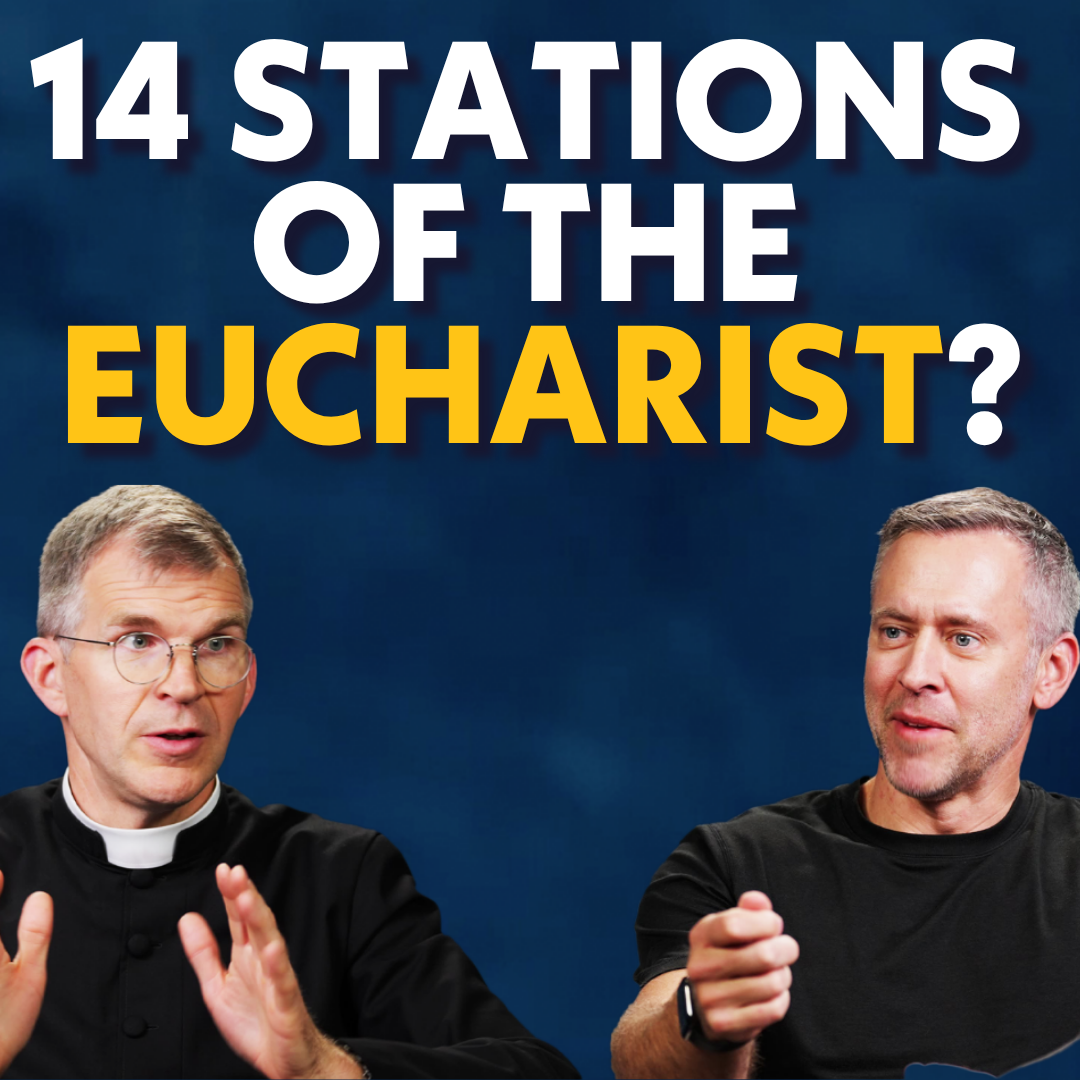
I'll just keep using this. It works. And then I began being like, well, as a priest, I see, like, some of these biblical meditations may be different. So I removed some of the ones that the sisters had put in. I added some other ones. So I ended up with 14 stations of the Eucharist. And I created a little booklet myself.
And the more that I began to preach it, the more I began to realize that this was all about the sacrifice. And it was all about a lamb being sacrificed from the moment of Abel, the first sacrifice that a man ever offered to God, which is the first sacrifice recorded in the Bible that man offers to God, which is the sacrifice of Abel to the sacrificial lamb. In the Book of Revelation, it is all about the sacrifice of a lamb.
And it all points to the one perfect sacrifice, which is Christ on Calvary, where the Lamb of God is slain for our salvation and how we participate in that at the Mass.
And so the 14.
[00:22:08] Speaker A: I love that man. The Lord led you to an understanding of this through your preaching. It's like so often through the things that are coming out of our mouths and the things we're doing. He's like, no, I'm having you do this for yourself, you know, to get you closer to me to using this to draw you as close to me as the people you're talking to.
[00:22:26] Speaker B: So you and I Were talking earlier about art.
So I'm very blessed. In my pastoral assignment, I have three summer festivals. I have a lot of parishes. We have three summer festivals.
[00:22:38] Speaker A: And I. You have the coolest parish life going on, man. So cool.
That's a whole other show.
[00:22:42] Speaker B: Anyway, I create an art display every summer.
[00:22:45] Speaker A: Yeah.
[00:22:45] Speaker B: Sometimes it's on nativity scenes or the Blessed Mother or Last Supper or different things. And one year, I decided to make the 14 stations of the Eucharist. So you're talking about how sometimes your preaching converts you the preacher.
So I created the 14 stations of the Eucharist. And each of the 14 stations, I had like a big artistic display of the station, the biblical passage, and allowed people just to go through this experience of the 14 stations in art form. When I would lead people through it, that's when I actually, for the first time, it hit me what actually was going on.
And that was when I became convinced that I needed to preach this and I needed to get this message out.
I had created a little booklet and I had to go and re edit the booklet because what I had originally put in the booklet about the 14 stations didn't connect it as, this is about the sacrifice of the Mass. And so I went and redacted it, and then I began to preach it. And then I preached at a men's conference in Palm beach. And the talk that I gave went on YouTube and got like 900,000 views. And then that's where it all.
[00:24:06] Speaker A: Oh, man, that's awesome.
You. Let's see here. You quoted this one guy, Father, I've been a daily Mass for 60 years, and I never knew the Mass was a sacrifice.
What happened that we lost sight of this? I mean, honestly. And even in the era where we were pushing the real presence because the world forgot about that. And people would say, well, he's present everywhere. Well, sure, so is water. And yet I need a water fountain. Right? So there's. He's present everywhere and here's a water fountain.
But even in that era, like, how did we lose sight of this? And how does it kind of change everything when you realize that other aspect, the communion, the presence and sacrifice, has it changed how you see, well, the Mass and frankly, yourself, it really does change everything.
[00:24:54] Speaker B: Because when I know that I have a place that I can take my sacrifices, my struggles, my difficulties, my trials, that I'm not alone in this world and I'm not just going to be with Jesus in his presence, which is beautiful, but I'm actually able to go to Calvary with This and be transformed. And to know that whatever suffering I have or whatever suffering is going on in the world or whoever I know that needs redemption, we can actually participate in that. So if you talk to priests across our country, at most parishes, the line of people coming in to have Masses offered is dried up.
[00:25:44] Speaker A: Why my parish, some of this stuff, it's like, who buried it? Did someone.
[00:25:48] Speaker B: My parish?
[00:25:49] Speaker A: And why would they bury this?
[00:25:50] Speaker B: My parish actually features other parishes Mass stipends because so people. There are so many people that come to our parish asking for Mass intentions.
[00:26:02] Speaker A: Oh, wow, you kids don't have enough Masses for all the intentions.
[00:26:06] Speaker B: Yeah, we can't get them sent enough. And so we have other parishes that come to us asking for Mass stipends and intentions that they offer because no
[00:26:15] Speaker A: one's in that parish for someone who's died.
[00:26:18] Speaker B: I know priests that offer their daily Masses offered for people's birthdays and there's no money attached to it. There's no one coming in and having the Mass offered because we. There is no thought of someone in their 30s or 40s or 50s that I should go and gosh, like, someone just died. I should have four Masses set for them. Oh, someone has cancer. I should go to the parish office and have a Mass set for them because they have cancer. And the best thing that I could do is have their name attached to the sacrifice, which is Calvary.
[00:26:44] Speaker A: Man.
[00:26:47] Speaker B: Like, someone very possibly is going to go to a priesthood. Hey, Father, could you pray for me? But we've lost that notion of the fact that, Father, could you offer a Mass for this intention?
Like that's the most powerful thing that a priest can do is offer a Mass. Intention for what? Someone who's living or deceased or whatever the situation might be.
And sadly, that's been eroded away.
[00:27:15] Speaker A: When I think of sacrifice to the Mass, I mean, that communicates the love more powerfully than any other aspect. Right. It's not just come be with Jesus who is here, though that's also true, or come be with his people who are here, though that's also true. And he's present in the people and all that. It's come and receive the passionate love of God pouring out for you now.
[00:27:37] Speaker B: Well, what's also beautiful about it is if we understand the role as sacrifice, then we know why he is present.
He's present to allow us to be at the sacrifice and so that his presence is there. But it also then creates the communion because we're all there to participate, not in each other, not in fellowship. It's the first thing, we're actually there to actually all participate in the one thing that saves us. And so we were there for the right intention.
[00:28:16] Speaker A: So I don't know if you'd have insights into this, but why did that understanding get. It does seem to be an intentional burying of. And I've been in church world for a long time, and I don't know why, when I think of it as this passionate love that I see people sometimes in leadership who think language like sacrifice sounds like it's, oh, it's rolling by the clock too much to this. This time that we don't want to go back to.
What are you thinking? And maybe it's a demonic blindness. I don't get it, dude.
[00:28:44] Speaker B: Yeah, I think there's probably lots of explanations. The way that I look at it in the most charitable and loving way is, like, you know, with the renewal of the liturgy, there was a new emphasis. And that emphasis clearly was on us being together at the table of the Lord. And there was this new emphasis on being church. Like, that. That was a big emphasis. And, like, praise God for that.
[00:29:09] Speaker A: Like, we.
[00:29:09] Speaker B: We should be church. We should be family. We. Like, that was a new emphasis. That was an emphasis. And then coming out of the 90s was this new emphasis of, like, presence. Like, we have to get back to, like, that. This isn't just about us. This is about. Jesus is here and he's here, and we shouldn't be acting this way because it's the Eucharist, and we. We should have Steubenville conferences where we bring the monster and we put Jesus presence with a bunch of young people, and we should take Jesus presence and we shouldn't have him down the hallway. We should have Jesus presence in the church, and we should have adoration. And the way we receive communion matters because it's really Jesus and it's not.
So I think we naturally went from communion and went to presence, and. But I think it's just an emphasis.
But there's only so many things you communicate. I think we were so much. There was so much energy being caught up in what we were communicating that we just stopped communicating one of them.
[00:30:02] Speaker A: You know, it's funny.
There's a pendulum swinging that comes to mind, obviously, right? That maybe we think because this wasn't emphasized, we have to emphasize it, and therefore the thing that had been emphasized is bad, and you've kept this balance, which is really beautiful, because a lot of people who say, no, no, we have to emphasize sacrifice would then throw out the communion and there's very traditional and traditionalist churches where there's a vibe. Right.
Where it's almost wrong to welcome someone in the door because it's 100%, this is it. Right.
You've managed to keep both those things going because if you're a pendulum guy, what you're going to do is eventually cause it to swing back the other direction because your kids are going to see the flaws in what you were doing.
[00:30:48] Speaker B: Yeah.
[00:30:48] Speaker A: That church feels inherently unfriendly, and it should. It should be all of it.
[00:30:52] Speaker B: And so belonging and what you're leading to right there is that belonging precedes believing.
People will believe because they belong.
Like, this is what happens to parents when their kids go to school.
They no longer belong solely to mom and dad into the family unit. They now belong to their peers. They belong to their friend group. They belong to their sorority. They belong to their sports team. And then our ideas change, and then mom and dad are like, what happened? Who are you? I don't even know what you believe now is so radically. Because belonging precedes believing. And so belonging really does matter. Community matters. Church matters. It really does matter.
And we can say there's a time and place for that. Like, when is that? When do we make that happen? But nonetheless, like, it does have to be. All it does have to be communion, present, sacrifice. I think that sacrifice is a way for us to get to communion and presence in a more deeper and real way that actually is powerful.
[00:31:50] Speaker A: I would guess Jesus agrees with you. I want to circle back to these words because I said this is something we're going to dive into again. Let's pick up the thread up again.
I love the ADD Brain. All the threads are present, all at one time. Here's that one. Pray, brothers and sisters, that my sacrifice and yours.
Whoa.
What that means to me as a layman. It reminds me of the fact that, like, we talked about the beauty of the ministerial priesthood and how you're in Persona Christi in the person of Christ sacramentally. And yet I, as a layman, I'm also a priest. Right. I'm baptized.
I'm anointed priest, prophet and king.
A priest in a different way than my ministerial priest is a priest.
Talk to me about that. What does that mean for me? How does that affect, like, my daily life? How does that affect me at Mass?
How am I supposed to see myself as a priest?
[00:32:42] Speaker B: Yeah, absolutely. So those words.
And I will say once again, I'm a priest of 23 years, and I can't tell you the amount of times that I've just said, pray, brothers and sisters, that my sacrifice and yours will be acceptable to God, the Almighty Father.
[00:32:55] Speaker A: May the Lord accept.
You know. Yeah, it'll be rattle stuff.
[00:32:58] Speaker B: I can tell you, Chris, that I now intentionally pause.
Pray, brothers and sisters, that my sacrifice and yours may be acceptable to God.
[00:33:14] Speaker A: So that's awesome.
[00:33:16] Speaker B: As a priest, there is no prescribed official prayer that is said at the end of universal prayers, or the prayers of the petition or prayers of the faithful, or people use different words for them. But oftentimes the priest just makes up a spontaneous prayer to end the petitions and the prayer that I often pray, which is going to answer your question here I say something like this.
Almighty God, Father, Son and Holy Spirit, we praise you and thank you for everything.
We ask you to hear these prayers and petitions, those that have been spoken, those we hold in the silence of our hearts.
We place them onto the patent, into the chalice, we unite them to the bread and to the wine, so they may be brought into your one perfect sacrifice. Jesus Christ, who died, rose again, abides in our tabernacles and lives, and reigns forever and ever. Amen.
Your life. Pray, brothers and sisters, that my sacrifice and yours is called to be put onto the paten, which is the golden plate, into the chalice, which is the cup, is to be united to the wine and to the bread, to be united into the one perfect sacrifice. If you could go to Calvary today and you were kneeling next to the blessed mother and St. John, the beloved disciple, what would you pray for your children?
What would you say to Jesus about the suffering that you're currently enduring, your wife is currently enduring, Your children are like, what child would you literally take and hold up to Jesus on the cross and say, help them, huh?
[00:34:55] Speaker A: And your answer is, you're here, do it. You're here at Calvary, do it.
[00:34:59] Speaker B: That is what we're supposed to be offering to the Mass at that moment
[00:35:05] Speaker A: and our very selves, right? I mean, the priest, the ministerial priest offers himself with the Eucharist, I got to come and offer myself. I got to bring it. Yeah, I love that you pause there.
You know, honestly like to worship in spirit and truth. Real, real renewal in the church and liturgical renewal. Sometimes we focus on externals and over focus on them.
And they are important, right? But the all important is that internal shift that'll bring about any external shift that we want.
What I mean by that, some people think like, well, if we just make the Mass what it was in 1963, then the world will change. But you had a 19. And by the way, if someone loves traditional Latin Mass, praise God, go for it, lead.
[00:35:48] Speaker B: Amen.
[00:35:48] Speaker A: Whatever the church lets you do, you know, I'm not going to make rules that the church is not making, which a lot of people like to do nowadays. You know, this is how it needs to be. No, it needs to be. Here's the parameters set by people in actual authority, which is not a random YouTuber, right? But within those parameters, the change of heart brings about the change that we need, you know, and so people think if I just change the words. Well, dude, in 1963, you had plenty of priests rattling through the words with. I actually heard this was. It made me laugh. It was Kennedy's funeral mass, and it was obviously the Latin Mass. And it sounded like this.
The guy was going so fast. Archbishop Chaput told me that they totally irreverent, right? But when they were in seminary and a lot of the guys weren't that serious, they were having races to see who. They had side alters to see who could send a higher mass. And they were getting through, the record was 19 minutes for a Trident team Mass. I'm thinking, like, I'm sorry, external form doesn't equal the right mindset, the right conversion of heart.
When you pause, whatever mass you're going to, whether you're Byzantine, Tridentine, Newmass, whatever one it is, thanks for that example. We got to take the pause, take a breath, say, what am I saying to think about what I'm thinking right now?
[00:37:05] Speaker B: Well, the basic premise is lex orandi, lex korandi, the rule of law, the rule of prayer.
How we pray is what we believe.
So what we believe is how we pray. How we pray is what we believe. That there's a direct lex orandi, lex credendi, the rule of law, the rule of prayer.
So the rule of belief, the rule of prayer. Pray, brothers and sisters, that my sacrifice and yours just stop right there. Like, let's just unpack that. Let's have a whole series of sermons on that, right? So one thing that we do at my parish is before Mass begins, the priests, we do announcements before Mass.
And so the priest comes out to give the announcement. And at the end of the announcements, the priest says, please turn to your neighbor and simply ask your neighbor, what's one thing going on in your life that I can pray for?
And then after you hear that one thing, I ask of you to unite that prayer intention to the bread, to the wine, on the chalice, in the paten. So that we're praying for each other and offering each other into the Holy Mass.
[00:38:15] Speaker A: Wow.
[00:38:16] Speaker B: And then for a minute and 30, we allow the people to share a prayer intention with the person next to them.
And then at that Mass, we're no longer just praying for myself, I'm actually praying for the person next to me.
[00:38:29] Speaker A: So I think it brings up the priestly role. I'm to offer sacrifice to God, to bring people to God. Bring God to people.
[00:38:36] Speaker B: I think a great question is clearly the words are in the Mass already about a sacrificial nature.
If someone goes through and reads the Eucharistic prayers and we begin to look at.
It's there already.
But we need to be reawakened and have our eyes open to this. And then I think also then pastorally, and this is why we're doing this right now at my parish, how do we also then help people understand that a huge part of the Mass is what I'm bringing?
And it's not me bringing something to Mass doesn't mean that I'm singing or I'm cantering or I'm reading or I'm taking up the gifts. No.
Every single person is called to active participation at the Mass. And that means that I'm actively entering into the sacrifice, which is Christ.
So as a pastor, how do I teach people to do that?
It's the one thing. What's the one thing I can do in your. Sorry, what's the one thing going on in your life that I can pray for? Campaign. We had like little braces made up for a while at our county fair.
We have booths and that's all they do at the booth.
What's one thing going on in your life that I can pray for? We are passing out miraculous medals.
[00:39:50] Speaker A: Or tribes literally open a booth and ask, stop by, tell me what they pray for. And we're going to write it down.
[00:39:55] Speaker B: And then what we do is we write them all down. And then we have two perpetual adoration chapels with my pastorate and we just. All those prayer intentions are left there.
[00:40:02] Speaker A: We complicate evangelization too much.
[00:40:04] Speaker B: Yeah.
[00:40:05] Speaker A: It's so non threatening.
[00:40:06] Speaker B: Yeah. What's one thing?
[00:40:08] Speaker A: I'm going to bring this to the Lord.
[00:40:10] Speaker B: Absolutely, man.
[00:40:11] Speaker A: That's cool.
[00:40:12] Speaker B: But I have been told by so many parishioners that I've sat next to this person for 20 years. Number one, I didn't know their name and number two, I didn't know anything about them.
[00:40:24] Speaker A: Wow.
[00:40:24] Speaker B: And now I've heard about their friend who has cancer and their Son who lost their job or their daughter who had a miscarriage or.
And now when I see them, I know them.
Isn't that being a church?
[00:40:42] Speaker A: Amen. I'm going to rip through some of these.
I mean, we don't have like three hours, but I do want to get like an overview, like from the 35,000 foot view about each of these stations of the Eucharist to give us a vibe for what all this is. Because it's really praying like this helps draw you into the reality. Right?
You mind doing this?
[00:41:02] Speaker B: Let's do it.
[00:41:02] Speaker A: Let's do it. All right. And your marks said go. The first station, the sacrifice of Abel.
[00:41:07] Speaker B: Sacrifice of Abel. So it's an offering. So this is the first time that man ever offers a sacrifice in recorded scripture. And we as great Bible fearing Christians, we always look at this story as the fact of like, don't kill your brother.
And we never get to the fact of like, well, why did God accept Abel's sacrifice?
God accepted Abel's sacrifice because Abel's sacrifice was the only sacrifice that was a symbol, a typology, a foreshadowing of the only sacrifice that would ever be accepted in the totality, which is Christ. Christ is the perfect lamb. And so Abel's sacrifice is offered because it is a symbol. So a question attached to that is like, what am I offering to the
[00:41:52] Speaker A: Lord,
[00:41:57] Speaker B: What am I giving to the Lord?
And how is it a symbol and united to Jesus?
[00:42:04] Speaker A: So cool. Second station offer him Melchizedek, the high priest. Melchizedek.
[00:42:09] Speaker B: I love Father Mike Schmitz.
So I did Bible in the year and catechism of the year. And this chapter struck me because of course Melchizedek is this mysterious character. He's a priest, he's a king, he has no ancestry and he offers a sacrifice of bread and wine. That's normally where we stop. We normally stop there and listen to Father Mike Schmitz.
And he's going through the Old Testament and talking about Jesus and talking about tribes and the tribe of Levi and the tribe of Judah and all the 12 tribes.
Jesus is not from the tribe of Levi.
He can't offer a sacrifice. And in fact, people who try to offer sacrifice after the tribe of Levi is establishes the priestly tribe get killed and bad things happen to them.
So Jesus needs to associate himself with a new priesthood.
And that's why the order of Melchizedek lives on forever as we hear in the Psalms and the book of Hebrews. And that's why this is so important, because the priesthood of Jesus Christ is not a priesthood that is determined by bloodlines and hereditary lines. It is a new priesthood.
And as we mentioned earlier, we just need to be thankful for the priesthood because it is Christ's priesthood.
[00:43:33] Speaker A: That's awesome. So the first one, you're meditating on sacrifice and how to make good sacrifice. Next station, you're meditating on the gift of the priesthood. The third station, the sacrifice of Abraham. So a lot of these are typology and stuff in the Old Testament pointing to what's fulfillment.
[00:43:45] Speaker B: Amen. So the sacrifice of Abraham. I think about it every single Mass, because I normally mention Abraham.
We actually say the sacrifice of Abraham if the priest chooses.
If the priest uses eucharistic prayer number one.
[00:43:59] Speaker A: That's a long one.
[00:43:59] Speaker B: The sacrifice of Abraham.
[00:44:02] Speaker A: That's the one where if I have a three year old with me, I hope the priest is going with eucharistic prayer number two. That's right.
It's beautiful. I'm sorry. Correct.
[00:44:10] Speaker B: So the sacrifice of Abraham. What? Interesting.
If I just say the sacrifice of Abraham. If you type in sacrifice of Abraham and click on images, all you're going to see is images of a man just about to kill his son. But that's not the sacrifice of Abraham.
[00:44:26] Speaker A: Huh?
[00:44:27] Speaker B: That's not the sacrifice of him. What is the sacrifice of Abraham? The sacrifice of Abraham is an adult male lamb whose head is in a crown of thorns.
The sacrifice of Abraham is a ram caught in a thicket who is a replacement sacrifice of the son.
And every single one of us needs a replacement sacrifice, which is Jesus. Jesus is my replacement sacrifice. He's your replacement sacrifice. He's. Everyone's like, we should all die for our sins. And Jesus chooses to die in our place.
[00:44:55] Speaker A: He still would pay the price.
[00:44:56] Speaker B: Yeah.
And so that typology is beautiful.
And once again, I think, like just with Abel.
[00:45:07] Speaker A: I'm so grateful you just said this because I've never.
I've fallen the same thing. Because every piece of artwork.
[00:45:13] Speaker B: Correct.
[00:45:13] Speaker A: Shows him with his knife raised above his son.
[00:45:15] Speaker B: Correct.
[00:45:16] Speaker A: Ready to give it all.
[00:45:17] Speaker B: But even in every one of those artworks, there's always in the corner an image of the ram caught in the thicket.
[00:45:26] Speaker A: Yeah.
[00:45:27] Speaker B: Which is actually the replacement sacrifice that actually appeases God.
And it's a Thanksgiving sacrifice for his son, living in replacement of him, which is every mass that's done.
[00:45:40] Speaker A: That's just too cool. See you guys. I'm gonna go meditate on that the rest of the day.
The sacrifice of. I mean, Eucharist means thanks I mean, this is the sacrifice of thanksgiving that the Lord died in my place or, you know, died to atone for. To pay the price.
[00:45:57] Speaker B: Correct. Because you should die. You, Chris Stefanick should die for your sins.
Your son and your daughter and your wife should die for their sins. But because Jesus loves us, he dies in our place. He's our replacement sacrifice.
[00:46:11] Speaker A: And our sacrifice becomes thanks.
[00:46:13] Speaker B: And he has a crown of thorns on his head.
[00:46:15] Speaker A: Man.
Fourth station, Jewish Passover.
[00:46:20] Speaker B: Well, I mean, what does this have
[00:46:22] Speaker A: to do with the eucharist? I'm kidding.
[00:46:23] Speaker B: St. John Chrysostom, Bishop, Father of the Church, Doctor of the Church.
In his beautiful reflection, he says, just as the Israelites ate the flesh of the lamb and put the blood on their doorposts, we as Christians, how much more will we be saved from death because we eat the flesh of the lamb and the blood of Jesus is on our lips.
Every Mass is us entering into the paschal sacrifice because he is the Lamb of God. When the priest turns to the people, he says, behold the Lamb of God. Behold him who takes away the sins of the world. That is the Lamb of God who fulfills the Old Testament sacrifice and death passes over us. What does Jesus say in John chapter 6?
He who eats my flesh and drinks my blood has eternal life and will raise them up in the last day.
For my flesh is true food, My blood is your drink.
[00:47:16] Speaker A: Okay, so again, this book is all. It's all short meditations on this, but if I want to actually pray these stations, I don't have time to read this entire thing every day.
[00:47:26] Speaker B: That's a great question. Did you know that there's also a booklet, There's a prayer booklet where you can actually pray the stations every day, just like praying the stations of the Cross. There's actually a prayer booklet companion to this book.
[00:47:37] Speaker A: That was my slow pitch to you.
The fifth station, the manna from heaven.
[00:47:44] Speaker B: Daily Mass.
What did I not know about. I didn't know we had daily Mass. Turns out, though, when we were in the desert, the Israelites were in the desert, God fed them every day. Not just on Sundays, not just on Saturday nights, not even just on Wednesdays.
He fed them every single day. He gave them bread from heaven.
What does Jesus say in John chapter six?
Unlike your ancestors who ate and died making reference to the manna, I am the true bread come down from heaven.
[00:48:15] Speaker A: Amen.
[00:48:16] Speaker B: So this is actually an invitation. This whole chapter is an invitation to go to daily Mass. The daily Mass is not for the elect. That daily Mass is not for the Elite. The daily Mass is not for, like, the Shiite Catholics. Daily Mass is for everybody. And the norm should be us trying to get to daily Mass.
[00:48:31] Speaker A: It's food.
[00:48:33] Speaker B: It's amazing.
[00:48:34] Speaker A: 6th Station, the Ark of the Covenant.
[00:48:35] Speaker B: Oh, my gosh, I love the Ark of the Covenant. Why? Because I do love presents.
And the Ark of the Covenant is the presence of God among his people in the Old Testament. And we have a tabernacle in every single Catholic Church, normally with two angels on either side of it.
[00:48:52] Speaker A: Bethlehem, the house of bread. The seventh station.
[00:48:54] Speaker B: I mean, house of bread.
[00:48:57] Speaker A: Bethlehem.
[00:48:58] Speaker B: Bethlehem. So clearly he says, I am the bread of life. And he is laid in a feeding trough.
And we sing beautiful songs like Away in a Manger. Because the little Lord Jesus asleep on the hay,
[00:49:15] Speaker A: he is the food.
I'm really excited to just start praying this, honestly, because it takes intentionality to enter in to anything, really. You know, I interviewed my good friend Dom Rosso, Navy seal. He's like, I want to get in the zone. When I'm coming home from work. I pass a stop sign. That's my trigger to get in the zone. So that I put my real game on when I come in to my wife and kids.
[00:49:38] Speaker B: Amen.
[00:49:39] Speaker A: We need to put the game, the real game on when you go to Mass. And this kind of prayer is so intentional. It's not just general prayer to help get my heart ready. Don't think this is a prayer for the sacrifice.
The eighth station. John the Baptist points to the Lamb of God.
[00:49:53] Speaker B: So this is, I think, where the Old Testament and the New Testament are completely brought together. Because every Old Testament reference, when John the Baptist says, behold the Lamb of God. Behold him who takes away the sins of the world, which is what he says on the River Jordan. Every single person who is a Jew there, automatically their mind is going, perfect. Offering Abel, replacement sacrifice. Abraham, I have to eat his flesh and his blood is going to redeem me. Passover lamb.
John, you're crazy.
He's an offering. He's a replacement sacrifice. I need to eat him.
He's going to take away my sins.
But that is exactly what John is saying.
That is exactly what John is actually saying. No. Yes.
He is the perfect sacrifice. He's a replacement sacrifice. And you're going to have to eat
[00:50:36] Speaker A: his
[00:50:38] Speaker B: body and his blood will redeem the whole world.
And that's what the priest says at every single Mass. The words of St. John the Baptist, behold the Lamb of God. Behold him. Takes away the sins of the world. Blessed are those called to the Supper. Of the lamb.
[00:50:49] Speaker A: You know, this is one liberty some artists take. So a prey animal has his eyes kind of on the side of his head, so he could see all around, get ready for something that might attack him. And a predator has him in the front in good eyesight, so they could home in on their prey. And very frequently the Lamb of God is depicted with eyes in the front. And that's not. Not a mistake. You know, here's the sacrifice. Who's gunning for you?
So cool.
[00:51:12] Speaker B: I love it. Never heard that before. Thank you.
[00:51:15] Speaker A: Yeah. Next time you see the eyes in the front, it's not a bad art mistake. It's like, oh, wow, that means something.
The ninth station, the wedding feast at Cana.
[00:51:25] Speaker B: Very simple.
Jesus can change substance.
I was an evangelical non denominational Christian for a little bit of my life.
And our Protestant separated brothers and sisters don't believe that Jesus has the ability to change substance.
[00:51:40] Speaker A: Are you telling me that God can actually do that?
[00:51:42] Speaker B: Yeah. And what's amazing is that nobody fights on the fact that like that Moses turned water into blood.
[00:51:48] Speaker A: Right.
[00:51:50] Speaker B: No Protestant pastor is arguing that.
[00:51:53] Speaker A: It's so believable. When you think about God, why are we. And why wouldn't he do this if he loves us?
[00:51:59] Speaker B: So the word transubstantiation is. Is that that chapter just delves into that. That, yeah, God has the power, if he had the power with Moses, to change water into blood. If Jesus Christ can turn water into wine, then we can clearly turn water wine into blood.
[00:52:14] Speaker A: Hallelujah. 10th station, multiplication of the loaves.
[00:52:16] Speaker B: Oh my gosh. Just the fact that God wants to feed the whole entire world with himself,
[00:52:22] Speaker A: you can't say that more beautifully. The 11th station, the bread of life discourse.
[00:52:27] Speaker B: This is very powerful. But in the book of Genesis, God says, do not eat or you will die about a tree. And if they eat from a tree, they'll die.
And now Jesus in John chapter six says, unless you eat, you will die.
So now we're commanded to eat. But where do we get that food from? From the tree, because we get it from Calvary, because the next chapter and the next station is station number 12, which is intentionally station number 12, because the stations of the cross. The 12th station is Calvary.
The 12th station of the Eucharist is the Last Supper. Because Calvary and the Last Supper are the exact same. They are the same.
And it's from the tree that Jesus says, take this all of you, and eat of it. This is my body, which is given up for you. And so John chapter six Unless you eat the flesh of the Son of Man, drink his blood, you have no life within you.
Go back to the Garden of Eden. Do not eat or you will die.
What tree do we get that from? We get it from Calvary. We get it from the cross, which has given us access to. At the Last Supper.
[00:53:44] Speaker A: Man, you love your priesthood.
[00:53:46] Speaker B: I do love the priesthood of Jesus Christ and I love.
[00:53:49] Speaker A: Yeah, it's just awesome. It's just I delight in seeing that. I really do. And as a layman, too, like, I. There's, you know, it can be tough as a layman in the church who has a particular charism and calling, you know, because there's some.
It's hard to say.
Sometimes I hit a wall where, like, I. Some dudes almost feel threatened.
You know what I mean?
[00:54:13] Speaker B: Yeah.
[00:54:15] Speaker A: But anybody with an anointing and charism and authority from God like you have as a ministerial priest who's confident in it and rejoices in it, is threatened by no one. And just want. I love going to your. So sometimes, you know.
Yeah. I love going to your parish doing reboot and just to see you delight in my gift and say, put this in front of my people, man. Shine it. Let it flow. Let it. You know, let the. Let the fire fall.
[00:54:40] Speaker B: You know, we want what's best for our kids.
You're my kids. I want you to have the best.
[00:54:46] Speaker A: Yeah, totally. Sorry, there was a total tangent, but I just. That just. I think that's because I thought about this since that reboot, you know, and that's where it comes from. That empowerment of laypeople comes from you just knowing it, being so comfortable in what you got and how awesome it is, you know, and that applies to anybody in any leadership because that's not just a priesthood. That's literally any CEO, any dad, anybody. It's so easy for people to feel threatened in their role and scared of usurpation, which, like, if you can rest in your own authority, then you can raise everybody up around you. Yeah. And I've said in a way that doesn't sacrifice.
[00:55:24] Speaker B: You've said this before, but I truly believe one of the great gifts of the new evangelization, one of the great gifts that has come out of the Second Vatican Council is individuals like you who are embracing the call to evangelize and to preach and to teach and to do what often we as ministerial priests aren't doing well.
[00:55:43] Speaker A: Yeah.
Yeah.
[00:55:45] Speaker B: You're creating content because there's a great hunger for it, because there's a lot of people that aren't getting that in the pew in their parish, and they're starving.
And so praise God for. For individuals like you and so many other lay Catholic evangelists, we host the E6 Catholic Men's Conference, which is a very large Catholic men's conference in Indiana. And it's run through my parish and we bring in speakers every single year. And pretty much for the last 11 years, they've all been lay people because that's who our men.
I want to put the best of the best in front of my men, my fathers, my grandfathers, my teenage men, because I want them to hear the best preaching, the best teaching. And right now, that's coming from sources that 50 or 60 years ago would never have been given a microphone.
[00:56:43] Speaker A: No, look, everything was Father this, Father that was a clericalism that would say that every charism is inherently tied to ministerial priesthood, which is completely unbiblical. You know, it's all of it. You know, but I. I'm just, I'm. I'm grateful.
[00:56:58] Speaker B: I'm grateful.
[00:56:59] Speaker A: Yeah. And. And there's, you know, there's a lot of great guys, like in bishops like you, because frankly, I wouldn't. I wouldn't have anything I'm doing. Yeah.
[00:57:06] Speaker B: And I'm not saying that there's great priests. There's great priests, great bishops out there speaking, but right now, like, there is an outpouring.
[00:57:13] Speaker A: Yeah.
[00:57:14] Speaker B: Of strong Catholic men and strong Catholic women that are out there rocking it and crushing it in such an effective way.
[00:57:22] Speaker A: Yeah. And the delight of raising each other up because I'll be preaching in front of audiences and say, look, dude, my whole mission is to lead you to what you're getting at the hands of Father.
[00:57:31] Speaker B: Yeah.
[00:57:32] Speaker A: And that doesn't make me feel diminished at all. You know, I'm talking about it. But the Lord loves you so much that me talking about it with a Britney Spears microphone on is not enough for the Lord's love for you. He wants you to taste and see, you know, and that's Praise God, man.
I love tangents. They're so fun. The 14th station. Wait, 13th station, the road to Emmaus, and then the 14th, the wedding feast of the Lamb. Those are the two that land at post resurrection stations. Go.
[00:57:58] Speaker B: So the 13 stations of the Eucharist.
[00:57:59] Speaker A: I say we're going to link below the video to this as well. You got to get this.
[00:58:03] Speaker B: Anyway, the 13th station, I always say, is my favorite station. And that's just because that's where it all happens.
So the two consecrations. This is my Body given up for you. This is my blood, which is poured out for you is the sacrifice. But then the recognizing of Jesus in the breaking of the bread, which I think ties us into that Eucharistic liturgy, when the priest fractions the host and breaks it and places it into the chalice, and we have the body and blood being brought back together, and we have this powerful announcement of the resurrected Lord.
Behold the Lamb of God. Behold him who takes away the sins of the world. Blessed are those called to the wedding supper of the Lamb, so they recognize him in the breaking bread. Who do they recognize? The resurrected Lord, which takes us directly to the wedding feast of the Lamb, which is John the Evangelist. Those last words are John the Evangelist. Blessed are those called to the wedding supper of the Lamb, which is the powerful part about the Mass. So if it is true, which it is.
If it is true that the sacrifice of Christ is the redemption of the world, and if it is true that the Lamb of God is before the throne of the Father in heaven and there are countless people in white garments, if I want to be at heaven, then I just need to go to Mass. And I am more close to. To my deceased relatives and friends at Mass than I am going and visiting their grave.
[00:59:37] Speaker A: Praise the Lord.
[00:59:38] Speaker B: And every saint in heaven is present at that Mass. Mother Teresa, John Paul ii, Father qt.
[00:59:44] Speaker A: Yeah, we're not starting a worship service at Mass. We're joining the one that never stopped.
[00:59:48] Speaker B: Amen.
[00:59:49] Speaker A: It never stops.
[00:59:49] Speaker B: Amen.
[00:59:50] Speaker A: I want to land on this because your book ends with this line from Fulton Sheen. The greatest love story of all time is contained in a tiny white host.
Soon to be blessed. Fulton Sheen. Yeah. The greatest love story of all time is contained in a tiny white host. I want you to just. There's your camera. Look at that camera. Talk to the guy who's a layman or a priest who's been going to Mass for years and just is kind of tired. And it's maybe missing the point of all this, frankly. Maybe missing the point of life. Thinks it's kind of boring. Maybe thinks God thinking about them.
What would you say to that person to kind of wake them up next time they go to Mass?
[01:00:33] Speaker B: The love of Jesus Christ is not something for us to just think about. The love of Jesus Christ for us on Calvary is not a Bible story. It's not a piece of artwork. It's not just biblical meditation.
The love of Jesus Christ on Mount Calvary and the empty tomb is real.
And Christ made it ever present for us.
And that's why going to Mass is so beautiful. Because every time you go to Mass, you are at Calvary and you are at the empty tomb. You are present with the whole entire church.
And God wants you to go there.
Jesus wants to meet you there, not just in his presence, which is awesome, to receive in Holy Communion, but he wants you to actually come with your whole entire life, your struggles, your sorrows, but also your gratitudes and your joys. And he wants you to lay them on the altar and he wants to just have you, just give everything.
It's the greatest love story.
It's the greatest love story in the whole entire world of Jesus Christ, God giving himself to his Father and us entering into that one perfect worship, which means that your life has purpose and beauty. And you should be bringing every single person you know in prayer and intention and even physically bringing them to the Mass so that they can be present at the Mass as well.
If we understood this, we would bring everybody we know to Holy Mass.
[01:02:05] Speaker A: As I say at the gym. Bring it.
[01:02:06] Speaker B: Amen.
[01:02:07] Speaker A: Bring it.
Close us out in prayer. Pray for all our viewers, pray for us, give us a blessing. And then I'll lead people who are watching to pray for you and for our priests.
[01:02:16] Speaker B: In the name of the Father and the Son, the Holy Spirit. Amen. Dear Lord, thank you for this day. Thank you for the opportunity to be with my brother Chris. Thank you for Real Life Catholic and for the great work that they're doing. And dear Lord, I want to right now place before you every single person who will watch this video in its entirety or parts of it, those who are going to share it with other people.
And dear Lord, I just ask that you send an outpouring of your Holy Spirit upon them, that you give them healing and grace and peace and confidence and fortitude and zeal in ways that they have never experienced before.
And I pray that the four senses of the Eucharist will be a tool to bring that about in their own lives.
So I ask you to bless everyone watching this today through the intercession of Our lady, through the intercession of St. Thomas Aquinas, the intercession of St. Carlos Acutius and all the saints. For I ask this in the name of your son, Jesus Christ, who died, who rose again, who lives and reigns forever and ever. Amen. God bless you all. In the name of the Father and of the Son and of the Holy Spirit.
[01:03:15] Speaker A: Amen. And Lord, I thank you, Father Jonathan, for all our priests. We ask you as they minister to us and feed us in your name and standing in your place in a way that's tangible for us. Because you love us that much. Give us that.
That they would first and foremost, know that they are your children, that you are their father.
And know and feel the great presence of youf love, filling them up from the bottom of their feet to the top of their head and flowing out through every part of them, through everything they do. That yout would be their food. That yout'd be their sustenance as they feed us. So that they wouldn't grow tired or weary, but grow in ever growing strength as they. As they near heaven. In your Holy name, Jesus, our High Priest, we pray.
[01:03:58] Speaker B: Amen.
[01:03:59] Speaker A: Hallelujah. Glory to the Father, to the Son, and to the Holy Spirit. As it was in the beginning, is now, and ever shall be, world without end. Amen. Mary, Mother of Priests, pray for us. Father, Son, and Holy Spirit. Amen. Hey. I love you, man. Thank. What a great time together. What a great hour that kind of flew by.
And thanks for doing this.
Thanks for. Thanks for everything.
[01:04:17] Speaker B: You're welcome. The station is the Eucharist. Let's go.
[01:04:19] Speaker A: Yeah.
[01:04:21] Speaker B: Thank you. Thank you. Thank you. Thank you.
[01:04:22] Speaker A: Yeah. I love you guys. Thanks for watching. See you next time.