Episode Transcript
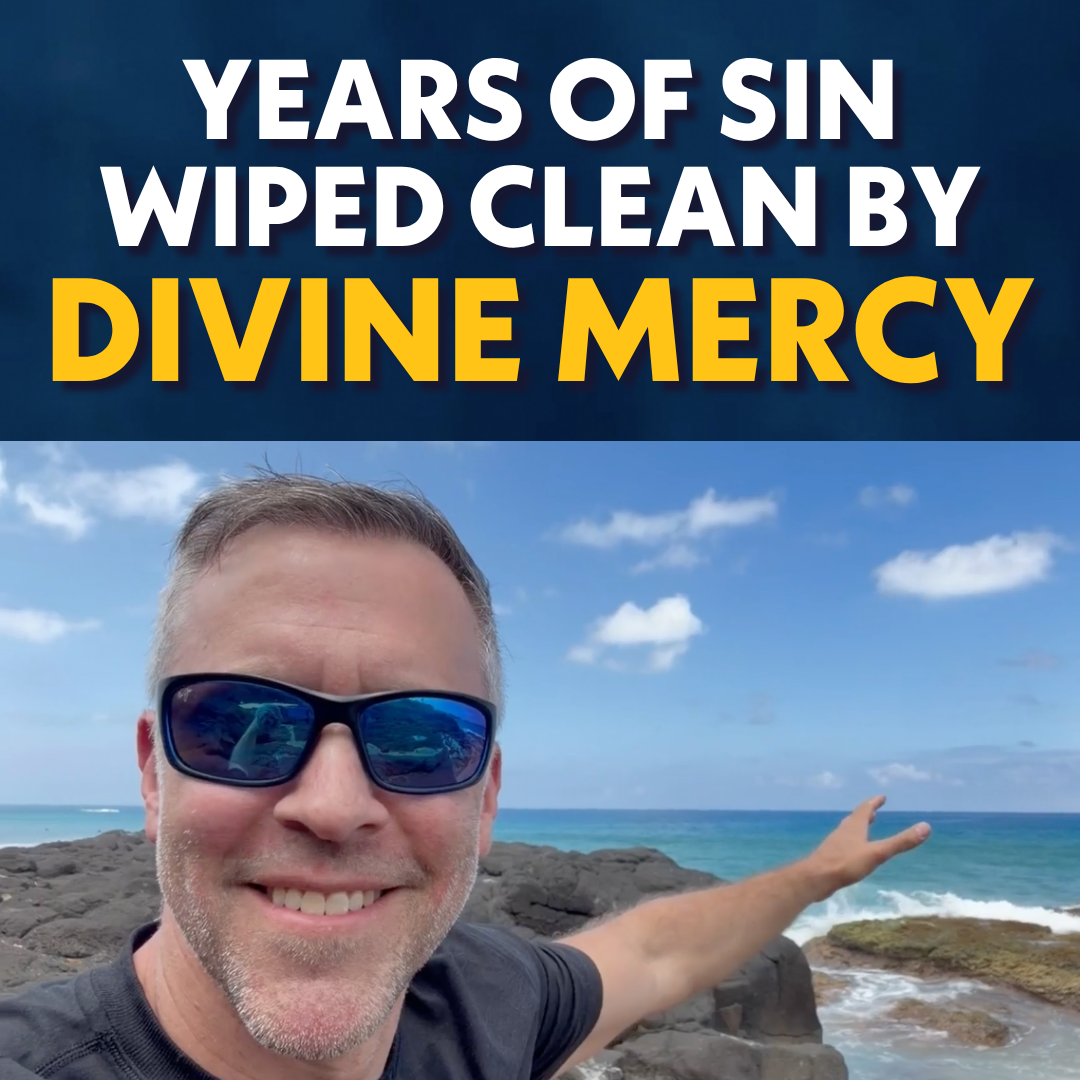
[00:00:00] Greetings, friends, from Kauai, where I'm with 40 pilgrims and what we're calling our Pilgrimage to Beauty. It's going to be an incredible retreat. We're praying for you guys. Please pray for us to have a blessed experience. But I'm also here because my father in law was baptized. He lives in Oahu. I brought my family out. He was baptized at the age of 85.
[00:00:21] We win, guys. To watch a lifetime of questions, of searching, and of sin. Sin washed away in an instant. That is how powerful the love and mercy of God is. When Jesus appeared to St. Faustina with the message of divine mercy. And if you've never heard of these apparitions or divine mercy, Sunday, we'll link below the video so you can learn all about it. But when he appeared to St. Faustina, he said, my mercy is like the ocean and your trust is a bucket. The bigger your bucket, the more mercy you can get. Guys, the limit to receiving God's love and mercy and grace is not determined by the size of your sin or the size of your questions or the size of your obstacles. The only thing that limits is your lack of trust in his mercy. Dude, he loves you. He showed you. He couldn't show you more powerfully than he did on the cross.
[00:01:11] Trust him. Jesus, we trust in you is the great prayer of divine mercy.
[00:01:16] Jesus, we trust in you. All your sins, all your questions, all your lifetime and dysfunction. It is a pebble.
[00:01:21] See, when you look at yourself, sometimes, that's all you see. No, no, no. It's a pebble next to the ocean of divine mercy.
[00:01:30] Just throw it in. Jesus, we trust in you.
[00:01:33] But guys, divine mercy isn't just something to celebrate. It's not just something to ask for for yourself.
[00:01:39] Divine mercy, the mercy of God and mercy is love in action. It said the mercy of God is something we're supposed to imitate.
[00:01:46] My kids got to go this week to an incredible place called Kalapapa. Kalapapa is a little peninsula on the base of the tallest sea cliffs in the world. You only go there by special invitation and with clearance from the health department. It's really hard to get in. Actually, if you're interested in coming with me, I'm trying to pull off a small pilgrimage because it can't be too big because it's just really hard to get in there, like I said. But if you're interested in coming with me, if I'm able to pull this off, sign up below this video and I'll let you know when this opens up. If it opens up, pray it does.
[00:02:13] But they got to go this week to visit one of the most beautiful sites in the world. I mean, this is so much untouched beauty, it's crazy. I mean, there's herds of Axis deer just running around untouched. They said, daddy's like being in a fairy tale. In the mid-1800s, it was a site of an absolute nightmare. Leprosy broke out in the Hawaiian Islands, and it was terrifying. People didn't know quite how you got it. They didn't know how. You know. They didn't know anything about the disease at all. They just knew that it made you die a very horrible, painful death. Now there's three people still living on this, in this colony that have what we now call Hansen's disease. You don't die a horrible death from it now, and you don't get it easily because of something called antibiotics. But we didn't have that back then.
[00:02:52] So the terror was so widespread in these islands that if you so much as had a really bad skin rash, you might be ripped away from your family, from your parents, from your wife, from your kids, and shipped off to this island at the base of the sea cliffs where you couldn't escape.
[00:03:07] It wasn't a sanctuary. It was a prison in many and, guys, it was complete anarchy. It wasn't just people dying there.
[00:03:16] There was no mercy.
[00:03:18] The strong dominated the weak.
[00:03:21] There was sexual abuse. There was little tribalism happening. And when it came time for you to die, very frequently people found themselves dying alone, just laying in the mud as their bodies fell apart with no one to care for them. And guess who walked in the midst of that chaos, in the midst of that anarchy, in the midst of that. Of that absolute misery?
[00:03:42] The Catholic Church.
[00:03:45] Guys, say what you want about Catholics.
[00:03:47] I've been to some of the most difficult places in the world.
[00:03:51] You do not find humanistic, secular, atheist organizations giving their lives there. If you want to find the people who stay there for life, who live with the poorest of the poor, the neediest of the needy, people in absolute abject poverty and misery, you know who you're going to find? You're going to find Catholic priests and nuns, consistently. That's who you're going to find in the midst of that absolute misery.
[00:04:13] Father Damien, a priest from halfway around the world, comes over here to give his life for them. And he didn't leave. He didn't just come in for a little service project trip. He stayed with them. He gave them dignity. He taught them the faith. He prayed for them. He held their hands while they died. He had no real significant medical training, but he gave them the medical care that he could. He built churches for them. And my daughter was telling me one of the most meaningful and most moving things that she saw there, that in the church, you could walk into it and see it still, there's little holes cut out. See, Father Damon experienced that while he was leading in Mass, people would frequently have to leave to spit because toward the end of your life, if you had leprosy, it's a very phlegm filled disease, so they have to constantly spit. The phlegm they were developing, it was really, really gross and really difficult to deal with.
[00:05:04] So Father Damien would see them having to leave worship to go spit outside. And he decided to cut little holes in the floor and build funnels for them so they could sit, kneel, stand and hold these long funnels and spit into those funnels and not have to interrupt their prayer. And at the end of Mass, he would crawl under the church he had made in this little opening, and there was so much of it that had collected that he'd scoop it all out for the next service.
[00:05:29] Unsurprisingly, Father Damien contracted leprosy himself. He would usually begin preaching by saying, you lepers, my friends, my brothers, my sisters, until one day he said, we lepers.
[00:05:40] And he was canonized not long ago. So St Damian of Molokai prayed for us. He was joined by another religious sister who gave her life in service to the church, St. Mary Ann Cope. The church was trying to. Trying to recruit, invited dozens of convents to come and help Father Damien in this desperate mission.
[00:05:56] Nobody wanted to go, and she said, okay, we'll come. She spent her whole life there. Now she developed a lot of the medical procedures people still use to this day, that you touch someone who's infected with this piece of equipment. Put a piece of tape here, you clean it off, put it there, don't touch your face. In between, she and her sisters did not contract leprosy, and she was also recently canonized after giving her life in service to this place. Spent decades with these people.
[00:06:21] Another guy whose cause is opened for canonization, Joseph Dutton. He had lived through the civil war, got ptsd, became an alcoholic, needed so much mercy himself, got divorced, ended up praying in a Trappist monastery for a time, and then heard about Molokai and said, you know what? I'm about to throw my life away. Why don't I throw it away in love and mercy for other people?
[00:06:43] So he didn't feel disqualified.
[00:06:45] Because he was such a broken mess.
[00:06:49] He said, I'm a broken mess, but I'm your broken mess. Lord, I'm going to give it all to you. His cause is open for canonization. Joseph Dutton, pray for us. So pray that the Lord works a miracle so that he's beatified, canonized, and the world could see the sanctity of this incredible man. But he spent. He lived there till his old age, didn't get leprosy. At the end of his life, he was blind. He walked around by the people he was serving. They ended up loving and serving him. Guys, what happened to Molokai is a great summary of how we're supposed to respond to divine mercy. People, people are messy, people are filled with phlegm.
[00:07:21] And it's easy to look at them from a distance, to look at all of us from a distance, through our filters, through our posts on Instagram that look just right and say, oh, that person's life is just fine. Get up close and personal and it's a mess.
[00:07:35] It always is.
[00:07:36] I mean, I love my father in law. He's got 85 years of stuff and questions and sins and all this stuff like anybody, like anybody's got.
[00:07:45] But Mercy says, when I see the phlegm, I'm sorry to be gross, but we're gross. We're a mess.
[00:07:54] When I see the phlegm, I'm not going to run from it. I'm going to get right down with you in it.
[00:08:01] I'm going to step onto that beach.
[00:08:04] I'm going to give my life for you, just like Jesus did for me.
[00:08:09] Lord, thank you so much for your mercy, which is as wide as the ocean.
[00:08:14] We trust in you, widen our hearts to imitate your mercy toward others.
[00:08:20] Amen.
[00:08:22] God bless you guys. I love you. See you next time.